



.png)

The Comprehensive Guide to Sourcing Wholesale Eyeglass Frames for Your Business
In the world of commerce, there is an age-old truth that every successful entrepreneur eventually realizes: “You don’t make your profit when you sell; you make your profit when you buy." Imagine a customer walks into your boutique, tries on a pair of sleek, hand-polished frames, and marvels at the quality. In that moment, your success isn't just about the sale—it’s about the weeks of vetting, negotiating, and strategic sourcing that allowed you to put that specific wholesale eyeglass frame in their hands at a price that wins for both of you.
The global optical market has undergone a seismic shift, moving from localized boutique sourcing to a complex, interconnected global network. For any retail entity or optical professional, understanding how to navigate the procurement of wholesale eyeglass frame units is the difference between a struggling storefront and a high-margin enterprise. This guide serves as a deep dive into the mechanics of bulk acquisition, ensuring that your inventory remains both trend-relevant and economically viable.
1. Introduction to the Wholesale Eyeglass Frames Market
Entering the world of bulk optical procurement requires a fundamental shift in mindset. It is not merely about buying more; it is about understanding the supply chain's architecture to leverage better pricing and exclusive access.
1.1 What Does "Wholesale Eyeglass Frames" Actually Mean for Your Business?
In the context of a professional optical enterprise, "wholesale" refers to the acquisition of goods directly from manufacturers or large-scale distributors at a price significantly lower than the Manufacturer's Suggested Retail Price (MSRP). When you engage with optical wholesalers, you are essentially removing the multiple layers of retail markups that occur in a traditional middleman-heavy supply chain. This process allows a business to acquire wholesale eyewear in quantities that justify steep discounts, enabling the retailer to set competitive price points while retaining a healthy gross profit.
1.2 The Economic Role of Wholesale Buying in the Optical Industry
The optical industry thrives on volume. Manufacturers of wholesale glass frames operate on thin margins per unit but find profitability through massive production runs. By participating in this ecosystem, your business acts as a vital link that translates industrial-scale production into consumer-ready fashion. Wholesale buying stabilizes the market by providing manufacturers with predictable demand, which in turn allows them to invest in better materials and innovative designs.
1.3 Why Shifting from Retail to Wholesale Sourcing is Essential for Scalability
Scalability is nearly impossible when buying through secondary retail channels. To grow, a business must transition to optical wholesale sources. This shift allows for:
- Inventory Depth: Having enough stock to never turn a customer away.
- Brand Identity: The ability to curate a specific "look" for your shop by selecting unique wholesale eyewear frames.
- Financial Leverage: Using the capital saved on procurement to invest in marketing or advanced diagnostic equipment.
|
Aspect |
Retail Sourcing |
Wholesale Sourcing |
|
Unit Cost |
High (MSRP) |
Low (Factory Price) |
|
Volume Requirement |
Low/Single Units |
High (MOQs Apply) |
|
Profit Potential |
Limited (20-40%) |
High (100-300%+) |
|
Direct Support |
None |
Dedicated Account Managers |
2. Strategic Advantages of Buying Eyeglass Frames in Bulk
The decision to buy in bulk is a strategic financial move that impacts every facet of your business operations, from the balance sheet to the customer experience.
2.1 Maximizing Profit Margins Through Low Unit Costs and Volume Discounts
The primary driver for wholesale optical procurement is the margin. When you buy wholesale eyeglass frames, the price per unit often drops significantly as the order volume increases. This "economies of scale" principle means that a business ordering 500 frames pays far less per unit than one ordering 50. These savings are the engine of your business’s net income.
2.2 Maintaining Consistent Inventory Levels to Meet Customer Demand
There is nothing more damaging to a brand than "out of stock" signs. Buying wholesale glasses in bulk ensures that your displays are always full. In the optical world, customers often choose frames based on immediate tactile feedback; if the frame isn't there to be tried on, the sale is lost to a competitor.
2.3 Gaining Access to Exclusive Designs and the Latest Seasonal Trends
Top-tier wholesale optical products are often reserved for bulk buyers. Manufacturers prioritize their large-scale partners when releasing new collections. By establishing a relationship with an optical wholesaler, you gain early access to the latest shapes, colors, and material innovations before they hit the general market.
2.4 Reducing Shipping Overheads per Unit with Consolidated Bulk Orders
Shipping a single frame from an international manufacturer is cost-prohibitive. However, when you import wholesale optical frames in large crates, the shipping, handling, and customs brokerage fees are distributed across hundreds of units. This dramatically reduces the "landed cost" of each item.

3. How and Where to Find High-Quality Wholesale Eyeglass Frames
Finding the right source requires a blend of digital savvy and traditional networking.
3.1 Leveraging B2B E-commerce Marketplaces for Global Wholesale Access
Digital B2B platforms have revolutionized how wholesale optical eyewear is sourced. These marketplaces allow you to browse thousands of manufacturers from regions like Italy, China, and Japan simultaneously. They provide transparency in pricing and allow for easy comparison of specifications for wholesale optical glasses.
3.2 Navigating Wholesale Directories to Identify Verified Distribution Hubs
Industry-specific directories are goldmines for finding a reliable optical wholesaler. These lists often categorize suppliers by their specialty—whether they focus on luxury brands, budget-friendly options, or specific materials like wholesale acetate eyeglass frames.
3.3 Attending International Optical Trade Fairs for Direct Wholesale Networking
Events like MIDO (Milan) or Vision Expo (New York/Las Vegas) are essential for serious buyers. These fairs allow you to touch the materials, test the hinge tension, and meet the faces behind the brand. It is the best place to find wholesale fashion glasses that haven't even hit the digital catalogs yet.
3.4 Local vs. International Wholesalers: Choosing the Right Source for Your Region
Choosing between a local optical wholesale partner and an international manufacturer involves balancing speed and cost. Local wholesalers offer faster shipping and easier returns, while international factories offer the lowest possible prices for wholesale spectacles.
4. Identifying and Vetting a Reliable Wholesale Partner
Not all suppliers are created equal. Vetting is the most critical step in protecting your investment.
4.1 Evaluating the Wholesaler’s Reputation and Market Credibility
Before committing to wholesale eyeglasses, research the company’s history. How long have they been in business? Do they have a physical presence? A credible wholesaler will have a track record of consistent supply and professional communication.
4.2 Assessing the Breadth and Diversity of the Wholesale Product Catalog
A good partner should offer more than just a few styles. Look for a catalog that covers various "entities" in the optical world: children's frames, sports eyewear, and classic professional styles. This diversity allows you to use a single source for all your eye frames wholesale needs.
4.3 Verifying Quality Compliance Standards (ISO, CE, and FDA Certifications)
Since eyewear is a medical device accessory, compliance is non-negotiable. Ensure the supplier of wholesale frames eyeglasses meets international standards.
- ISO 12870: Specifies fundamental requirements for unglazed spectacle frames.
- CE Mark: Essential for the European market.
- FDA Registration: Required for sales in the United States.
4.4 Checking Wholesale Reviews and Past Buyer Feedback for Reliability
Look for testimonials from other wholesale opticians. Direct feedback regarding shipping delays, product defects, or communication issues can save you from a disastrous partnership.
|
Certification |
Region |
Importance |
|
FDA |
USA |
Legal requirement for medical-grade frames. |
|
CE |
Europe |
Ensures health, safety, and environmental protection. |
|
ISO 9001 |
Global |
Quality management system consistency. |
5. Navigating the Wholesale Transaction: Key Terms and Considerations
Understanding the "language of wholesale" is vital for a smooth transaction.
5.1 Understanding Minimum Order Quantities (MOQ) for Wholesale Pricing
The MOQ is the lowest number of units a supplier is willing to sell to maintain wholesale optics pricing. Some factories may require 100 units per style, while others might allow "open stock" where you can mix and match styles to reach a total dollar amount.
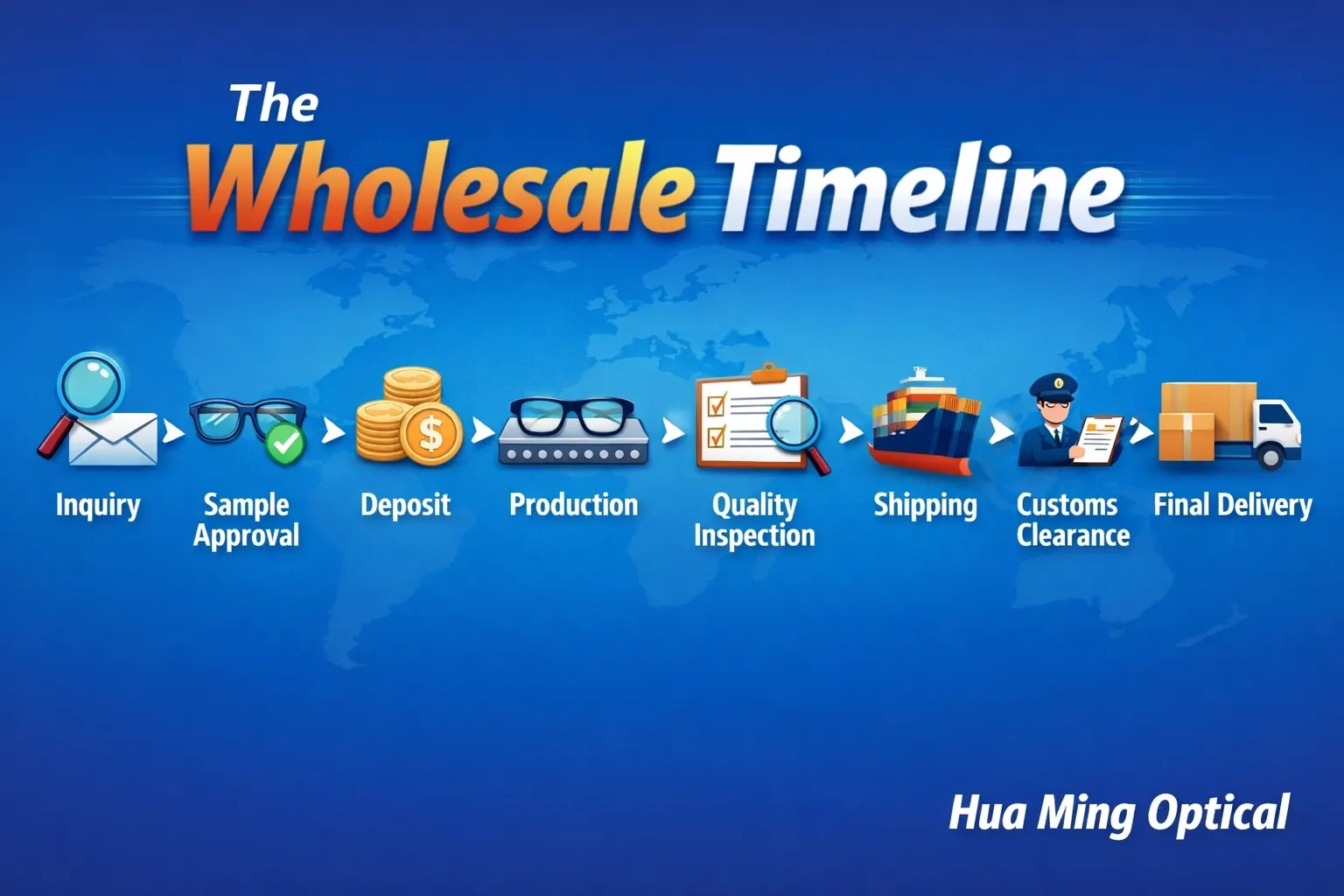
5.2 Analyzing Lead Times: From Order Placement to Warehouse Delivery
When sourcing wholesale glasses frames, timing is everything. Lead time includes production, packaging, and transit. For custom orders, this can be 60-90 days. For ready-to-ship stock, it might be 7-14 days. Proper planning prevents inventory gaps.
5.3 Establishing Secure Payment Terms and Credit Lines in B2B Transactions
Most wholesale optical deals begin with a deposit (e.g., 30% T/T). As your relationship grows, you can negotiate "Net 30" or "Net 60" terms, allowing you to pay for the frames after you have already started selling them to your customers.
5.4 Clarifying Return and Exchange Policies for Defective Bulk Stock
Even the best optical wholesalers occasionally have a batch with defects. Ensure your contract clearly states the process for RMAs (Return Merchandise Authorizations). Who pays for return shipping? Is it a refund or a credit for future eyeglass wholesale orders?
6. Quality Assurance: What to Inspect Before Finalizing a Wholesale Deal
You cannot sell what you do not trust. Quality assurance (QA) is the gatekeeper of your brand's reputation.
6.1 Testing Material Durability: From High-Grade Acetate to Lightweight Titanium
Materials define the price point. When inspecting wholesale acetate eyeglass frames, look for "hand-polished" finishes and wire-core temples. For metal options, ensure that metal eyeglass frames wholesale batches use nickel-free coatings to prevent skin irritation, a common complaint with low-quality bulk items.
Industry Insights: Selecting the Right Foundations
Selecting the right material is a balance of aesthetics and functionality. For instance, when a retail business partners with a reliable metal eyeglass frames supplier , the focus should always be on the grade of the alloy used. While acetate offers vibrant colors, high-quality metal frames provide a minimalist durability that many professional clients prefer. Finding a dedicated metal eyeglass frames source ensures that your inventory includes lightweight, hypoallergenic options like titanium or stainless steel, which are essential for maintaining a versatile and high-margin collection.
6.2 Evaluating Component Integrity: Hinges, Screws, and Nose Pad Quality
The moving parts are where frames usually fail. Test the "spring hinges" for smoothness. Check if the screws are coated to prevent loosening. High-quality wholesale optical products will use medical-grade silicone for nose pads rather than cheap, hard plastics.
6.3 Ensuring Consistency in Finishing and Color Across Large Batches
In eyewear wholesale, consistency is a sign of a professional factory. If you order 100 "Tortoiseshell" frames, the pattern and hue should be consistent across the entire lot. Significant variations suggest poor quality control during the tumbling or coloring process.
6.4 The Importance of Requesting Pre-Purchase Samples Before Bulk Commitment
Never place a large order without seeing samples. Samples allow you to verify that the wholesale glass frames match the digital photos. It also lets you test the "glazing" process—ensuring that lenses can be fitted easily without the frame cracking or warping.
|
Material |
Key QA Check |
Best For |
|
Cellulose Acetate |
Luster and Flexibility |
High-end fashion, deep colors. |
|
Stainless Steel |
Coating adhesion |
Durability and hypoallergenic needs. |
|
Titanium |
Weight-to-strength ratio |
Premium, lightweight comfort. |
|
TR-90 |
Memory retention |
Sports and children's eyewear. |
7. Professional Negotiation Tactics for Savvy Wholesale Buyers
Negotiation in the B2B world is about mutual benefit, not just "beating" the supplier on price.
7.1 How to Negotiate Tiered Pricing Based on Order Volume
Ask for a price list that shows the "break points." For example, the price for wholesale optical frames might drop at 100, 500, and 1,000 units. If you are close to a threshold, it is often worth increasing the order to unlock the lower price tier.
7.2 Discussing Logistics: Who Covers Shipping, Customs, and Insurance?
Don't just look at the unit price; look at the "Incoterms."
- EXW (Ex Works): You pay for everything from the factory door.
- FOB (Free On Board): The supplier gets it to the port; you take over from there.
- DDP (Delivered Duty Paid): The supplier handles everything until it reaches your door. This is often best for new wholesale eyewear buyers.
7.3 Building Long-Term Strategic Partnerships for Better Priority Access
A loyal buyer gets better treatment. If you consistently source your wholesale spectacles from one vendor, they are more likely to offer you flexible payment terms, faster production slots, and first dibs on closeout sales.
7.4 Requesting Customized Wholesale Catalogs Tailored to Your Niche
If your business focuses on a specific demographic—say, petite faces or "alternative fit" bridges—ask your optical wholesaler to curate a selection for you. This saves time and ensures your inventory is highly targeted to your actual customer base.

8. Common Pitfalls to Avoid When Buying Eyeglass Frames at Wholesale
Even experienced buyers can make mistakes. Recognizing these traps is the first step in avoiding them.
8.1 The Risk of Overstocking Unpopular Designs Without Market Research
The low price of wholesale glasses can be tempting, but 1,000 units of an ugly frame is just wasted warehouse space. Always balance your "trend" buys with "staple" designs—classic rectangles and round frames that never go out of style.
8.2 Sacrificing Quality for the Lowest Possible Price Point
There is a floor to how cheap wholesale optical glasses can be before the quality becomes a liability. Extremely cheap frames break during lens insertion, leading to "re-do" costs that wipe out your initial savings. Focus on the best value, not the lowest price.
8.3 Ignoring the Fine Print in Wholesale Shipping and Handling Agreements
Hidden fees can destroy your margins. Always check for "document fees," "palletization charges," or "fuel surcharges" that might not be in the initial quote for wholesale optical eyewear.
8.4 Failing to Account for Import Duties and Local Taxes in the Final Cost
When importing wholesale eyeglasses internationally, your local government will likely want a cut. Depending on your country, duties can range from 2% to 20%. Use an online duty calculator or consult a customs broker to ensure your retail price covers these hidden costs.
|
Pitfall |
Consequence |
Prevention |
|
Dead Stock |
Capital tied up in unsellable items. |
Small test batches before large orders. |
|
Hidden Duties |
Unexpected 15-20% cost increase. |
Research HTS codes for eyewear. |
|
Poor Material |
High return rates from customers. |
Strict sample testing (stress tests). |
9. Conclusion: Future-Proofing Your Business with Smart Wholesale Sourcing
Mastering the art of wholesale procurement is a continuous journey of learning and adaptation. As consumer tastes evolve and manufacturing technologies improve, your sourcing strategy must remain agile. By focusing on quality, vetting your partners, and understanding the economic levers of the industry, you position your business to thrive in a competitive landscape.
9.1 A Recap of the Wholesale Buying Checklist
Before you sign off on your next shipment of wholesale optical goods, run through this final check:
- Are the certifications (FDA/CE) current and verified?
- Did the samples pass a durability and glazing test?
- Is the total landed cost (including shipping and duties) within your margin targets?
- Does the mix of styles align with your current sales data?
9.2 Final Thoughts on Maintaining a Competitive Edge in the Optical Market
The future of the optical industry belongs to those who control their supply chain. Whether you are looking for specialized acetate eyeglass frames to satisfy a boutique crowd or robust metal eyeglass frames options for a high-traffic retail outlet, the principles remain the same. Transparency, quality, and strategic volume are the pillars of success.
Partner with HUA MING OPTICAL
Ready to elevate your inventory with premium designs and unbeatable value? At HUA MING OPTICAL, we specialize in providing high-quality wholesale eyeglass frame collections that help your business stand out. From the latest trends to timeless classics, our catalog is designed to maximize your profit margins and delight your customers. Contact us today to request our latest wholesale catalog and discover how we can support your growth.
Featured Articles
Buying optical inventory in large quantities requires careful checking to avoid bad merchandise. This quality inspection checklist for bulk nylon eyeglass frame orders from China provides a clear roadmap for optical businesses. Nylon eyewear material offers high flexibility and impact resistance. Factories mix raw nylon pellets to create durable optical frames. Importers must verify the physical state of every shipment batch before final payment. A small defect in the raw material or hinge structure can ruin a large batch of eyewear inventory. This comprehensive guide helps businesses establish clear standards for their custom eyewear orders from Chinese production lines. Importers often face challenges with physical alignment and material stress points when ordering sports or casual eyewear frames. Testing the structural integrity of a nylon frame requires specific tools and steps. This physical verification checklist addresses cosmetic flaws, hinge tension, and dimensional accuracy. Businesses can use these steps to minimize customer returns and improve store ratings. Following a clear inspection structure protects your investment and maintains high store standards. 01. Visual Inspection and Surface Defect Checks Surface perfection is a vital part of eyewear quality control. Visual inspection helps detect common cosmetic flaws that happen during the injection molding process. Workers must inspect the raw nylon material under bright, neutral light. 1.1. Identifying Injection Molding Flaws on Nylon Eyewear Injection molding leaves specific marks if the machine settings are wrong. Weld lines appear where the melted nylon flows together inside the mold. These lines create weak spots that break under pressure. Sink marks happen when the thick parts of the plastic cool too fast and shrink inward. Air bubbles inside the transparent nylon material also ruin the look of the frame. Inspectors must check the entire surface of the front frame and temples for these issues. 1.2. Checking Color Consistency and Coating Adhesion Bulk orders often have color shifts between different production batches. The color of the temples must match the front frame exactly. Paint scratches or uneven spray coatings lower the retail value of the optical product. Technicians use a standard cross-hatch tape test to check if the protective lacquer coating sticks well to the nylon surface. Peeling paint means the factory did not prepare the nylon material correctly before spraying. 02. Structural Integrity and Stress Testing Nylon is famous for its flexibility and durability. Structural testing checks if the physical frame can handle daily wear without cracking or losing its original shape. 2.1. Flexibility and Twist Testing of the Front Rim Nylon frames must bend without breaking. An inspector holds the left and right rims of the empty frame and twists them gently in opposite directions. The nylon material should flex easily and return to its original shape instantly. Any cracking sound during this test means the factory used low-quality recycled plastic pellets instead of pure raw nylon. 2.2. Bridge Expansion and Impact Resistance Tests The bridge area connects the two lens rims and bears constant stress. Importers test this area by pulling the rims apart horizontally. The bridge must stretch slightly and snap back without any permanent bending. Impact testing involves dropping a small steel ball onto the frame from a set height to verify that the nylon structure will not shatter during sports activities. 03. Hardware, Hinges, and Assembly Quality The hardware parts connect the moving pieces of the frame. Metal hinges must bond perfectly with the nylon material to prevent loose temples. 3.1. Hinge Tightness and Screw Alignment Verification Hinges must move smoothly without feeling loose or too tight. Inspectors open and close the temples ten times to feel the resistance. The small screws must fit flat inside the hinge barrel. Loose screws or stripped threads mean the temple will wobble over time. Spring hinges require extra attention to confirm the internal mechanism retracts properly. 3.2. Checking Injected Metal Core Pins Many nylon frames use a thin metal wire inside the temples to allow easy adjustments. This wire core pin must sit exactly in the center of the nylon temple. If the wire is too close to the surface, the plastic can melt or crack during hot weather. The wire must also be completely straight without any rust spots. 04. Dimensional Accuracy and Fitment Checks Eyeglass frames must match the design drawings exactly so that standard optical lenses fit into the rims without falling out. 4.1. Lens Groove Depth and Rim Circumference The groove inside the rim holds the optical lens in place. Inspectors use digital calipers to measure the depth and width of this groove at four different points. If the groove is too shallow, the lens will pop out when the user drops the glasses. If the groove is too deep, the frame rim becomes too thin and weak. 4.2. Temple Length and Front Frame Width Measurement Every size marking printed on the inside temple must match the physical measurements. Importers check the lens width, bridge width, and temple length against the approved sample sheet. A variation of more than 0.5 millimeters can cause fitment issues for the final customer. Frame Part Standard Target Allowable Tolerance Tool Used Lens Rim Width 52.0 mm +/- 0.3 mm Digital Caliper Bridge Distance 18.0 mm +/- 0.2 mm Digital Caliper Temple Length 140.0 mm +/- 0.5 mm Precision Ruler Groove Depth 0.8 mm +/- 0.1 mm Depth Gauge 05. Alignment, Symmetry, and Flatness Checks A crooked frame causes discomfort and distorts the user's vision. Alignment tests confirm that the frame sits straight on a flat surface. 5.1. The Four-Point Flat Surface Test Inspectors place the unfolded frame upside down on a flat glass plate. The two top rim edges and both temple tips must touch the glass at the same time. This is called the four-point test. If one temple tip stays in the air, the frame is warped. This warp happens if workers remove the hot nylon frames from the injection mold too quickly. 5.2. Temple Clamping Distance and Open Alignment The distance between the two open temples determines how tightly the glasses grip the wearer's head. Technicians measure the gap between the temple tips when fully open. The temples must spread out at equal angles from the front frame. Uneven angles mean one side of the frame will press too hard against the user's face. 06. Packaging, Labeling, and Final Lot Acceptance The final step ensures the product arrives safely at your warehouse without scratches or environmental damage. 6.1. Individual Polybag and Barcode Verification Each nylon frame must rest inside a soft protective polybag to prevent friction scratches during shipping. The bag should display the correct model number, color code, and barcode label. Wrong labels cause massive inventory confusion during retail distribution. 6.2. Master Carton Strength and Moisture Protection Moisture can degrade hardware components over time. Master shipping boxes must contain silica gel packets to absorb humidity inside the container. The exterior cardboard box needs to be thick enough to handle stacking pressure inside shipping vessels. Inspectors verify the total box weight matches the packing list documents. Detailed Summary of Quality Standards This quality inspection guide covers every critical check needed for large optical orders. Buyers must monitor surface defects like sink marks and weld lines during the visual stage. Testing structural flexibility prevents weak frames from reaching retail shelves. Hardware assembly checks confirm that metal hinges stay locked into the nylon body. Dimensional checks keep lens fitting accurate across thousands of units. Finally, alignment tests ensure comfortable symmetry for the end user. Using this complete checklist reduces production errors and keeps your bulk orders running smoothly. Choose Your Custom Manufacturing Partner Are you looking to secure a reliable supply of premium nylon frames for your optical business? Partnering with an experienced manufacturer is the best way to ensure consistent quality and hassle-free bulk importing. Contact Hua Ming Optical today to discuss your specific design needs and production volumes. Our manufacturing facility uses precise injection equipment and strict quality testing to deliver durable eyeglass frames nylon optical businesses can trust for long-term growth.
READ FULLThe production of premium eyewear requires high precision and strict control over materials. Brands look for consistency when they source bulk products from a factory. A professional metal eyeglass frames manufacturer must focus on every single step of production to avoid common mistakes. Buyers reject bad batches when they find structural errors or surface marks on the components. This guide highlights the main factory faults in metal eyewear production and explains how engineers fix them. Eyewear quality depends heavily on metal choices like stainless steel, titanium, and monel. Each material reacts differently to heat, pressure, and chemicals during the shaping process. Factories face huge losses when bad welding creates weak joints or when poor plating causes the color to peel off. Customers notice these errors quickly because the product sits directly on the face. Manufacturers must use correct cutting tools, proper temperature settings, and accurate alignment systems to keep the quality high. Understanding the root cause of these production flaws helps factories improve their delivery rates. We will examine the exact engineering issues that happen during cutting, welding, bending, and coating. We will also share the exact technical solutions that modern factories use to keep their items free of defects. 01. Material Selection Faults and Base Metal Impurities The quality of an eyewear frame depends directly on the raw material that enters the factory. When a factory uses low-grade metal alloys, the entire production run fails. Raw metals often contain tiny air bubbles or hidden cracks inside them. These invisible flaws happen during the raw melting stage at the metal mill. If the factory does not test the incoming wires and sheets, these impurities cause big problems later. Impurities weaken the molecular structure of the metal. When the hydraulic press stamps the metal sheet into an eyewear shape, the material cracks along the weak lines. This creates immediate waste. Even if the frame does not crack during stamping, the weakness remains inside the rim. The metal becomes brittle and snaps easily when a worker tries to insert an optical lens. To avoid this issue, factories must establish a strict material testing laboratory. Engineers must use chemical spectrometers to check the exact percentage of elements like nickel, chromium, and iron. The metal must match international standards exactly. Workers should also perform tensile strength tests to ensure the metal can bend without breaking. Buying raw materials only from certified mills protects the factory from bad base metals. 02. Incorrect Stamping and Blanking Pressure Stamping is the process where heavy machines punch out the basic shape of the front frame from a flat metal sheet. The machine uses a set of heavy steel dies that squeeze the metal under high pressure. If the calibration of the machine is wrong, the pressure becomes uneven. Too much pressure squeezes the metal too thin around the edges. This makes the rim weak and causes it to warp during daily use. Too little pressure creates a different kind of defect. The die does not cut cleanly through the metal sheet. This leaves thick metal leftovers on the edges of the frame. Workers call these rough edges burrs. Burrs damage the polishing wheels and prevent the plastic lenses from fitting correctly into the groove. The frame looks rough and unfinished. Factories solve this by installing electronic pressure sensors on all hydraulic presses. Technicians must check the alignment of the top and bottom dies every morning. The dies wear down after punching thousands of sheets, so they need regular sharpening. Automated CNC machines can also replace old mechanical presses to keep the cutting pressure perfectly uniform across the entire sheet. 03. Sharp Edges and Incomplete Deburring After the machine cuts the metal components, the edges remain incredibly sharp. These components include the eye-wires, the bridge, and the temple arms. A sharp edge can cut the skin of the user or scratch the clothing. Deburring is the mechanical process that smoothens these rough edges. Factories usually put the metal parts into large vibrating barrels filled with water and ceramic tumbling stones. Quality issues arise when workers do not leave the parts in the tumbling barrel long enough. If the tumbling cycle is too short, the ceramic media cannot smooth out the inner groove of the rim. The sharp edge stays hidden inside the frame. When the optical shop tries to snap a polycarbonate lens into the metal rim, the sharp metal edge chips the plastic lens. Managers must enforce fixed timing standards for the tumbling room. Different metals need different tumbling times. Stainless steel is hard and needs a longer cycle with heavier ceramic shapes. Copper alloys are softer and need a gentle cycle with plastic media to avoid dents. Inspectors must check the inside grooves of the frames with a special probe before sending the parts to the assembly section. 04. Poor Rim Lock Alignment and Thread Failures The rim lock is the tiny metal block that holds the eye wire together with a small screw. It allows the optician to open the frame, place the lens inside, and tighten it down. This small block requires perfect machining. If the factory drills the screw hole at a slight angle, the screw will not enter straight. A crooked screw strips the internal threads instantly. When the internal threads strip, the screw loses its grip. The screw backs out on its own when the user wears the glasses. The lens then falls out of the frame and breaks on the floor. Another issue happens when the top and bottom halves of the rim lock do not line up perfectly. This uneven gap creates an ugly line on the side of the glasses and makes the temple arm crooked. To eliminate thread failures, factories must use automated tapping machines that drill and thread the holes in a single sequence. High-speed cameras can inspect the threads inside the tiny holes automatically. The factory must use premium hardened steel screws that resist stripping. Applying a tiny drop of thread-locking fluid during final assembly also keeps the screw secure inside the block. 05. Weak Soldering and Hydrogen Embrittlement at the Bridge Soldering connects the different pieces of the frame together. High heat melts a filler metal between the bridge and the rims. Many factories use manual torch soldering where a human worker holds the flame. If the worker moves the flame too quickly, the filler metal does not melt completely. This creates a cold joint. A cold joint looks solid but snaps apart the first time someone drops the glasses. Overheating the metal during soldering creates an even worse problem called hydrogen embrittlement. When the metal gets too hot, it absorbs gas from the surrounding air. This gas changes the internal crystal structure of the steel or titanium. The metal near the weld joint becomes as brittle as glass. The bridge will snap right in half under very light finger pressure. Modern manufacturing facilities solve this by switching to automated induction soldering or laser welding. These machines heat the joint with extreme precision for a fraction of a second. The machine also floods the welding area with pure argon gas. The argon gas acts as a shield. It keeps oxygen and hydrogen away from the hot metal, which prevents any structural brittleness. 06. Inconsistent Temple Arm Bending and Spring Hinge Failures The temple arms must bend smoothly around the human ear. A mechanical bending machine curves the wire component to match a specific template. If the machine lacks proper calibration, the bend angle varies between batches. One arm might feel too tight against the head while the other arm fits too loose. This uneven fit makes the glasses slide down the nose of the user. Many premium frames use spring hinges inside the temple to provide extra comfort. These small hinges contain a tiny internal spring and a sliding piston. Quality issues happen when cheap factories use springs made of low-carbon steel. These cheap springs lose their tension after a few hundred flexes. The temple arms become floppy and lose their gripping force completely. Factories must use CNC wire bending machines that measure the spring back of the metal automatically. Different batches of metal have slight differences in elasticity, and a smart machine adjusts its bending force to match. For the spring hinges, the purchasing department must source springs made only from high-tensile stainless steel or beryllium copper. These premium materials maintain their spring force for over twenty thousand movements, which is why global brands look for these reliable internal parts when they decide to order custom metal eyeglass frames from an expert workshop. 07. Poor Surface Preparation Before Electroplating Electroplating deposits a thin layer of gold, silver, or gunmetal color onto the base frame. The electric current coaxes the metal ions to stick to the surface. However, plating will not stick to a dirty surface. During manufacturing, the frames collect cutting oil, polishing wax, and fingerprints. If these contaminants remain on the metal, the plating layer lifts up immediately. The plating might look good when it leaves the tank, but it hides a massive flaw. The oil underneath creates a barrier. Within a few weeks of use, the sweat from the skin of the user penetrates the thin plate. The gold layer begins to peel off in large flakes. This leaves the raw grey base metal exposed, which can irritate the skin of the consumer and cause allergic reactions. To prevent peeling, factories must install an advanced multi-stage ultrasonic cleaning line. The frames must pass through hot alkaline baths, acid neutralization tanks, and pure water rinses. Workers must wear lint-free gloves after the cleaning stage. Nobody should touch the bare metal frames with bare hands before they enter the electroplating tanks. 08. Inaccurate Electroplating Thickness and Color Variation Even if the surface is clean, controlling the thickness of the plated layer is difficult. The thickness depends on the time the frame spends in the chemical tank and the strength of the electrical current. If the current drops, the layer becomes too thin. A thin layer wears away within months of regular handling. The frame loses its color and exposes the dull metal underneath. Color variation happens when the chemical balance in the plating bath changes. The tank contains dissolved gold or copper ions. As the machine processes thousands of frames, the machine consumes these metal ions. If the technician does not add fresh chemicals regularly, the color drifts. A batch of gold frames might come out looking pale yellow or dark orange instead of the approved sample color. Plating Thickness Durability Rating Common Quality Result Less than 0.1 microns Very Poor Wears off within three months 0.25 to 0.5 microns Standard Lasts one year of normal use 1.0 to 2.0 microns Premium Grade Resists sweat corrosion for years Factories must use computerized dosing systems that add fresh metal concentrates to the tanks continuously. Technicians should use X-ray fluorescence thickness gauges to measure the exact micron level on sample frames from every batch. Keeping the electrical current perfectly stable with modern digital rectifiers ensures that the plating thickness remains uniform across all items. 09. Lack of Protective Clear Coating and UV Degradation Most metal frames receive a final layer of clear lacquer protective coating over the electroplated finish. This clear coat protects the shiny metal from scratches and chemical attack. If the factory skips this step to save money, the metal tarnishes quickly. Air and moisture react with copper and nickel alloys, which turns the frame green or brown over time. Quality issues also occur when factories use cheap clear coatings that cannot resist ultraviolet light from the sun. The sun shines on the glasses every day during outdoor use. Cheap lacquer turns yellow and foggy when exposed to solar radiation. The beautiful silver or gold shine underneath disappears behind a cloudy, cracked layer of old plastic coating. Factories must apply high-grade polyurethane or epoxy clear coats that contain specific UV-blocking additives. The coating room must maintain a clean environment to prevent dust particles from landing on the wet lacquer. Baking the coated frames in precise convection ovens ensures that the protective layer cures into a hard shield that stays crystal clear for years. 10. Nose Pad Arm Fragility and Misalignment The nose pad arms are the thin wires that hold the plastic nose pads in place. These arms require high flexibility because opticians bend them constantly to fit the nose of different people. If the factory uses an incorrect wire gauge that is too thin, the arm loses its structural strength. The weight of the heavy lenses will cause the nose pads to bend out of shape on their own. Fragility happens when the welding attachment point is too small. The nose pad arm snaps off the main rim easily if a user wipes the glasses with a cloth too firmly. Misalignment is another huge issue. If the left arm sits higher than the right arm, the glasses sit crooked on the face. This ruins the optical center of the lenses and causes headaches for the wearer. Engineers must use specific welding jigs that lock the nose pad arms into the exact position before applying the electric weld. The wire material should consist of tough nickel-silver or titanium alloys that can endure repeated bending without work-hardening. The inspection team must check the alignment using a fixed digital gauge that compares the left and right positions perfectly. 11. Inadequate Final Inspection and Alignment Sag The final assembly room is where the temple arms, front frame, nose pads, and screws come together. Even if every part is perfect, poor assembly can ruin the product. Workers must align the frame so that it sits completely flat on a level table. If the frame rocks back and forth when touched, the alignment is bad. This fault is known as alignment sag. Many factories rush the final inspection stage to meet delivery deadlines. Inspectors look at the frames quickly without checking the opening torque of the hinges. If the hinge screw is too tight, the user cannot open the temple arms easily. If the screw is too loose, the arms flop around like toys. Missing small scratches on the surface also leads to customer complaints. Factories must implement a strict four-point inspection check on every single finished item. Workers must place the frame on a calibrated glass plate to verify flatness. Digital torque screwdrivers must be used during assembly to ensure every screw receives the exact same tightness. Inspectors must work under high-intensity LED lights that reveal every hidden scratch or coating bubble before packaging. 12. Bulk Packaging Damage and Moisture Corrosions The final stage of manufacturing is packing the items for international shipping. Many quality issues happen after the goods leave the factory floor. If a factory packs thousands of bare metal frames tightly into a single cardboard box without individual protection, the frames rub against each other during transit. The metal parts scratch the polished coating off neighboring frames. Moisture corrosion is another huge risk during sea shipping. Sea air contains high amounts of salt and humidity. If the shipping container gets hot, moisture condenses inside the boxes. This humid environment causes the steel screws and base metals to rust inside the packaging before the client even opens the box. To eliminate transport damage, every metal frame must be placed inside its own soft plastic sleeve. The factory should use custom cardboard trays with individual foam slots to keep the frames separated. The inner walls of the master export carton must be lined with a waterproof plastic barrier. Placing multiple bags of silica gel desiccant inside the box absorbs any trapped moisture and keeps the metal frames completely dry during long sea journeys. 13. Manufacturing Process Control Table To help production managers track these issues quickly, the following data table summarizes the manufacturing faults, their main causes, and the engineering solutions. Production Stage Common Quality Issue Root Engineering Cause Factory Prevention Solution Material Sourcing Brittle frame breakage Impurities and air pockets inside the alloy wire Use chemical spectrometer testing on incoming metal rods Frame Blanking Thick rough edges (burrs) Worn stamping dies and incorrect hydraulic pressure Sharpen cutting dies weekly and install electronic sensors Component Finishing Scratched optical lenses Short tumbling cycles that leave inner grooves sharp Enforce longer vibrating cycles using correct ceramic media Hinge Assembly Stripped internal threads Crooked drilling and low-quality tapping tools Use automated single-sequence CNC drilling machines Bridge Attachment Broken nose bridges High heat causing hydrogen embrittlement Switch to automated laser welding with argon gas shielding Electroplating Tank Peeling gold color layers Wax, grease, or oil leftovers on the metal surface Install a multi-stage ultrasonic chemical cleaning line Color Finishing Pale or drifting color tones Low metal ion concentration in the chemical bath Deploy automated chemical dosing systems with X-ray gauges Final Assembly Crooked frame alignment Manual screw tightening without fixed torque limits Use digital torque screwdrivers and glass flatness plates Export Logistics Surface scratches and rust Friction inside boxes and high sea shipping humidity Use individual polybags, foam slots, and silica gel packs 14. Conclusion and Summary of Factory Best Practices Maintaining high standards in a metal eyewear factory requires constant attention to detail across every manufacturing department. Quality control is not a single step that happens at the end of production. It is a continuous system that begins the moment raw metal wires enter the warehouse. If a factory ignores material purity or machine calibration, the final products will always suffer from high defect rates. We have explored how minor errors in temperature, pressure, and chemical balance create major product failures. Uncalibrated stamping presses create sharp burrs that ruin the clean lines of the frame. Manual soldering torches often overheat the metal, which leads to weak bridge joints that snap under light pressure. Furthermore, poor cleaning before the electroplating stage causes beautiful gold and silver coatings to peel off within weeks of use. These issues damage the reputation of a brand and lead to costly product returns. To eliminate these common manufacturing defects, factories must shift away from manual processes and adopt modern automation. Automated CNC machines, laser welding units, and digital inspection tools ensure that every component matches the approved technical drawing exactly. Training workers to perform regular machine maintenance and enforcing strict quality checks at every station keeps production efficient. By implementing these engineering solutions, a factory can consistently produce durable, beautiful, and reliable eyewear that satisfies global buyers. 15. Partner for Premium Eyewear Production Finding a reliable partner who understands technical precision is the most important step for your eyewear business. A professional factory can transform your design concepts into durable products that stand out in the global marketplace. We focus on strict quality control at every stage of production to ensure that your bulk orders arrive without a single defect or surface flaw. Our engineering team handles every detail with care so that you can focus on growing your brand and serving your clients. When you choose a partner for custom eyeglass frame manufacturing and decide to work with Hua Ming Optical, you gain access to advanced manufacturing technology and experienced technicians. We utilize high-precision CNC stamping machines, automated laser welding systems, and advanced electroplating lines to achieve exceptional consistency across every batch. Our strict multi-stage inspection process guarantees that every frame delivers excellent durability and comfort. Contact our sales office today to discuss your production needs, request detailed material samples, and start your next successful product line.
READ FULLWhen you want to launch or grow an eyewear brand, you must choose the right manufacturing route. Many optical brands struggle to select between two popular business models. These models are private label manufacturing and original equipment manufacturing, which people call OEM. Both setups have unique benefits for companies that sell eyewear products. Choosing the wrong setup can cost your business a lot of time and money. If you want to buy and sell premium products, you need to look at premium custom metal eyeglass frames closely. Metal frames are very popular because they last long and look classic. Buyers always look for strong materials like stainless steel, titanium, and monel when they choose eyewear. The model you select will change how you design these products, how much money you spend upfront, and how fast you can sell them in the market. This detailed guide looks at the real facts of both business paths. We will check the production costs, design choices, and timeline differences. This information will help you pick the model that perfectly matches your current business size and your long term brand goals. 01. What is Private Label Metal Eyeglass Manufacturing? Private label manufacturing is a model where a factory makes pre-designed eyeglass frames. The factory already has the machinery, shapes, and tools to build these products. As a buyer, you select a finished frame style from their existing catalog. After you choose the style, the factory prints your unique brand logo on the inside of the temple arm or on the packaging. This model works like buying a ready-made house and putting your name on the front door. The basic structure and shape of the metal frames do not change. However, you get full credit for the product because it carries your business brand identity. It is a very fast way to enter the eyewear market without starting from scratch. 1.1. The Engineering Side of Private Label Frames From an engineering view, private label frames use standard molds. The manufacturer utilizes common alloy mixtures to build these items. They often use stainless steel sheets or nickel silver wires because these materials are easy to shape in mass quantities. The factory does not change its machine settings for your order. They use the same production line for multiple buyers who want the same basic frame structure. This system lowers the risk for the factory. Since they make the same shapes repeatedly, their workers do not make many mistakes. The cutting tools, welding points, and polishing wheels are already set up perfectly. This setup means the final product has a consistent quality level that you can trust. 1.2. Why Brands Choose Private Label Many small and medium eyewear brands prefer this model because it is simple. You do not need an industrial design team to draw blueprints. You also do not need to understand complex engineering rules for metal tension or hinge placement. The factory has already tested the frames for weight balance and comfort. Another major benefit is the lower investment risk. Since the factory does not build new tools for your order, you do not pay high development fees. You can use your money for marketing and sales instead of factory tooling. This path helps young companies test the market without losing big capital. 02. What is OEM Metal Eyeglass Manufacturing? Original Equipment Manufacturing, or OEM, is a completely different model. In this setup, you create a brand-new frame design from your own ideas. Your design team draws the blueprints and specifies every single measurement. You then hand these custom designs over to a factory, and they build the exact item according to your specific instructions. This model gives you total creative freedom over the final product. You do not choose from a catalog. Instead, you tell the factory what materials to use, how to cut the metal, and what special features to add. The factory acts as your physical production branch, turning your raw sketches into real, wearable products. 2.1. Custom Tooling and Mold Creation The biggest technical feature of the OEM model is custom tooling. When you give your blueprints to the factory, engineers must create new steel molds and stamps. These tools are unique to your brand and will not make frames for anyone else. The factory sets up specific CNC machines, which are computer-controlled cutting tools, to cut your exact shapes from metal blocks. This process requires a lot of technical precision. Engineers must calculate how the metal will bend under heat and stress. They build separate molds for the front rim, the nose bridge, and the left and right temple arms. This custom preparation takes a long time and requires a large initial payment. 2.2. The Value of Total Originality Brands choose the OEM route when they want to offer something completely unique to the market. If you want a special rim shape, a patented hinge mechanism, or an unusual combination of metal colors, private label cannot help you. OEM allows you to build an exclusive product line that stands out from all competitors. This originality gives you strong control over your market pricing. Since no other company can source the exact same frame, customers cannot easily compare your prices to cheaper brands. It helps you establish a high-end image and builds deep brand loyalty among consumers. 03. Design Freedom and Customization Comparison Design flexibility is a major factor that separates these two business systems. With private label metal frames, your customization choices are quite narrow. You can usually choose the color of the electroplating, which is the chemical process that colors the metal surface. You can select common finishes like shiny gold, matte black, or brushed silver. You can also pick the plastic tips that cover the ends of the metal temples for ear comfort. However, you cannot change the actual shape of the eye wire or the thickness of the metal bridge. If the catalog frame is fortyeight millimeters wide, you cannot ask the factory to make it fifty millimeters wide without switching to an OEM model. You must accept the structural design exactly as it exists in the factory warehouse. 3.1. Unlimited Options in OEM Production OEM production removes all design boundaries. You can mix different high-quality metals together in one frame. For example, you can design a pure titanium front rim for extreme lightweight comfort and combine it with flexible beta-titanium temples. You can also decide the exact depth of the groove that holds the glass lens. Feature Category Private Label Model OEM Model Design Source Factory Catalog Shapes Buyer's Custom Blueprints Material Choice Standard Factory Alloys Custom Selected Metals Logo Placement Pad Printing or Laser Engraving Deep Stamping or Custom Inserts Shape Modification Not Allowed Unlimited Modifications Hinge Options Standard Stock Hinges Patented or Custom Mechanisms This flexibility extends to functional parts too. You can design custom spring hinges that bend outward without breaking. You can create unique nose pad arms that fit specific facial structures better than standard global fits. Every single millimeter of the frame follows your business plan. 04. Minimum Order Quantities (MOQ) and Production Scale Factories operate on manufacturing scales, and they use Minimum Order Quantities, which people call MOQ, to manage their costs. In the private label model, MOQs are generally low. An expert metal eyeglass frames manufacturer might only ask for three hundred pairs per style. Sometimes they let you split this number across three different surface colors, meaning you only need one hundred pairs of gold, one hundred pairs of silver, and one hundred pairs of black. Low MOQs happen because the factory already owns the production machinery and molds. They can easily insert your small batch into their weekly production schedule. They do not lose time making new tools, so they do not need a massive order to cover their basic setup expenses. 4.1. High Volume Needs for OEM OEM orders have much higher MOQ demands. A factory will often require one thousand to two thousand pairs per single style before they accept an OEM project. They cannot lower this number because the engineering setup takes days of manual work. Workers must change the heavy steel molds inside large press machines, which stops the regular factory flow. If a factory runs a small batch on a custom mold, they lose money on machine downtime. Therefore, your business must have the capacity to buy, store, and sell thousands of units per style when you choose the OEM path. This model demands a strong distribution network that can move high volumes of stock quickly. 05. Cost Analysis: Initial Investment vs Unit Price The financial structures of private label and OEM are opposite in terms of upfront costs and long term savings. Private label requires very little upfront investment. You pay for the samples, the actual frames, shipping costs, and a small fee for logo application. There are no hidden engineering fees or development costs. However, the price you pay per individual frame is usually higher in private label. Since the factory did all the development work and takes the inventory risk, they charge a premium on every piece. Your profit margin per item will be lower compared to a high volume custom run. 5.1. Understanding OEM Tooling Expenses OEM requires a large amount of upfront money, which engineers call Mold and Tooling investment. You must pay for the physical creation of the steel dies and stamping plates. This cost can range from one thousand to several thousand dollars for each unique frame shape. If your design fails in the market, you cannot get this tooling money back. Financial Aspect Private Label Model OEM Model Upfront Tooling Cost Zero Dollars High (Thousands per Shape) Sample Development Low Cost and Fast Expensive and Multiple Stages Cost Per Unit Higher Per Piece Lower Per Piece at Scale Risk of Unsold Stock Low (Small Batches) High (Large Minimum Quantities) Profit Margin Potential Moderate Very High The benefit comes later when you look at the unit price. Once you pay for the tooling, the cost to stamp out each additional metal frame is very low. When you order large quantities over time, the average cost per frame drops significantly. This low unit cost gives you excellent profit margins when you sell the items to retail shops or consumers. 06. Time-to-Market and Production Timelines Time is a critical asset in the fast moving fashion and optical industries. Private label manufacturing offers the fastest route to market. Since the frames are already designed and the factory has raw metal components ready, production is fast. The factory only needs to schedule the electroplating, assemble the parts, print your logo, and pack the goods. A standard private label order takes about thirty to forty five days to finish. If the factory has the exact frames already sitting in their warehouse stock, the timeline can drop to fifteen days. This speed lets you catch current fashion trends before they disappear. 6.1. The Long Journey of OEM Development OEM development follows a much slower timeline. The process starts with technical drawings, which takes a couple of weeks. Next, the factory builds a single handmade prototype from brass or steel to check the look and fit. This prototyping stage takes twenty to thirty days. Timeline Phase Private Label Model OEM Model Design Approval 1 to 5 Days 2 to 4 Weeks Tooling and Molds 0 Days (Already Exists) 4 to 6 Weeks Prototype Testing 1 Week (Stock Sample) 3 to 4 Weeks Per Revision Mass Production 30 to 45 Days 60 to 90 Days Total Time-to-Market Around 1 to 2 Months Around 4 to 6 Months Once you approve the prototype, the factory spends another forty days building the hard steel mass production molds. After the molds are ready, actual mass production takes sixty to ninety days. In total, you might wait four to six months before you receive your first commercial shipment of custom frames. 07. Supply Chain Quality Control and Risk Management Quality control works differently under each manufacturing setup. In private label production, the factory owns the quality control system. They check the alignment of the metal rims and test the strength of the solder joints using their own standard guidelines. You have less control over the specific checks they perform. The risk here is that the factory might lower their quality standards to save money on material costs, and you might not notice until the goods arrive. To protect your business, you should hire a third party inspector to visit the factory before shipment. This inspector will check the frame coating thickness and hinge smooth movement. 7.1. Taking Charge of Quality in OEM With OEM manufacturing, your business can set the exact quality control rules. You can demand that the factory uses specific German screws, premium silicone nose pads, or a precise four-layer plating process. You can also dictate how many stress tests the temple arms must pass before packaging. The risk shifts to your design team in this model. If your blueprint has a mathematical error in the hinge angle, the factory will build it exactly like the drawing anyway. If the final frame pinches the ears of the wearer because of your design, the factory is not responsible. You own the design risk completely. 08. Mapping Business Goals to the Right Manufacturing Choice To choose the perfect system, you must look honestly at your current business position. A private label setup is ideal for start up brands, local optical shops, and corporate buyers who want a promotional product line. It lets you run an agile business that changes products quickly when customer tastes move from round frames to aviator shapes. It also suits companies that want to focus 100 percent of their energy on marketing and building an online audience. You do not get bogged down in industrial engineering problems. You simply choose beautiful shapes from a trusted supplier and build a strong brand identity around them. 8.1. When to Make the Move to OEM The OEM path is meant for established optical companies, famous fashion labels, and large wholesale distributors. You need a stable bank account to handle the upfront tooling fees and the cost of thousands of frames. You also need an experienced operations team that can manage long supply chain delays without running out of shop stock. If your core selling point is technological innovation or true design exclusivity, OEM is your only option. It allows you to build a protective wall around your products because no one can copy your exact source shapes. This model turns your business from a basic trader into a genuine product creator. 09. Conclusion Choosing between private label and original equipment manufacturing is a major strategic decision for your eyewear company. Private label offers an accessible path with low minimum order requirements, fast turnaround times, and zero engineering worries. It allows new brands to launch quickly using pre-tested metal shapes that customers already love. OEM provides absolute creative freedom, lower long-term production costs, and unique market differentiation, but it requires deep financial investments and months of careful development. You must balance your available budget against your need for original product design to find the right match. 10. Grow Your Eyewear Brand Today Building a successful eyewear line requires a reliable manufacturing partner who understands precision metalwork and strict quality standards. Whether you want to select stylish ready-made frames from an active catalog or develop an exclusive custom design from your own blueprints, professional factory support is essential. The right production team can handle complex alloy materials and advanced electroplating finishes to give your clients a comfortable product that lasts for years. You can take your optical business to the next stage by connecting with a trusted partner. Contact Hua Ming Optical Company to discuss your specific manufacturing needs and get a detailed quote for your next collection. Our experienced engineers will help you choose the best production path, manage technical specifications, and deliver premium metal frames that match your exact business goals.
READ FULL