



.png)

The Comprehensive Eyeglass Frames Sourcing Guide at Wholesale Prices for Your Business
In the world of commerce, there is an age-old truth that every successful entrepreneur eventually realizes: “You don’t make your profit when you sell; you make your profit when you buy." Imagine a customer walks into your boutique, tries on a pair of sleek, hand-polished frames, and marvels at the quality. In that moment, your success isn't just about the sale; it’s about the weeks of vetting, negotiating, and strategic sourcing that allowed you to put that specific eyeglass frame in their hands at a wholesale price that wins for both of you.
The global optical market has undergone a seismic shift, moving from localized boutique sourcing to a complex, interconnected global network. For any retail entity or optical professional, understanding how to navigate the procurement of wholesale eyeglass frame units is the difference between a struggling storefront and a high-margin enterprise. This guide serves as a deep dive into the mechanics of bulk acquisition, ensuring that your inventory remains both trend-relevant and economically viable.
1. Introduction to the Eyeglass Frames Wholesale Market
Entering the world of bulk optical procurement requires a fundamental shift in mindset. It is not merely about buying more; it is about understanding the supply chain's architecture to leverage better pricing and exclusive access.
1.1 What Does Buying Eyeglass Frames at Wholesale Actually Mean for Your Business?
In the context of a professional optical enterprise, "wholesale" refers to the acquisition of goods directly from manufacturers or large-scale distributors at a price significantly lower than the Manufacturer's Suggested Retail Price (MSRP). When you engage with optical wholesalers, you are essentially removing the multiple layers of retail markups that occur in a traditional middleman-heavy supply chain. This process allows a business to acquire wholesale eyewear in quantities that justify steep discounts, enabling the retailer to set competitive price points while retaining a healthy gross profit.
1.2 The Economic Role of Wholesale Buying in the Optical Industry
The optical industry thrives on volume. Manufacturers of wholesale glass frames operate on thin margins per unit but find profitability through massive production runs. By participating in this ecosystem, your business acts as a vital link that translates industrial-scale production into consumer-ready fashion. Wholesale buying stabilizes the market by providing manufacturers with predictable demand, which in turn allows them to invest in better materials and innovative designs.
1.3 Why Shifting from Retail to Wholesale Sourcing is Essential for Scalability
Scalability is nearly impossible when buying through secondary retail channels. To grow, a business must transition to optical wholesale sources. This shift allows for:
- Inventory Depth: Having enough stock to never turn a customer away.
- Brand Identity: The ability to curate a specific "look" for your shop by selecting unique wholesale eyewear frames.
- Financial Leverage: Using the capital saved on procurement to invest in marketing or advanced diagnostic equipment.
|
Aspect |
Retail Sourcing |
Wholesale Sourcing |
|
Unit Cost |
High (MSRP) |
Low (Factory Price) |
|
Volume Requirement |
Low/Single Units |
High (MOQs Apply) |
|
Profit Potential |
Limited (20-40%) |
High (100-300%+) |
|
Direct Support |
None |
Dedicated Account Managers |
2. Strategic Advantages of Buying Eyeglass Frames in Bulk
The decision to buy in bulk is a strategic financial move that impacts every facet of your business operations, from the balance sheet to the customer experience.
2.1 Maximizing Profit Margins Through Low Unit Costs and Volume Discounts
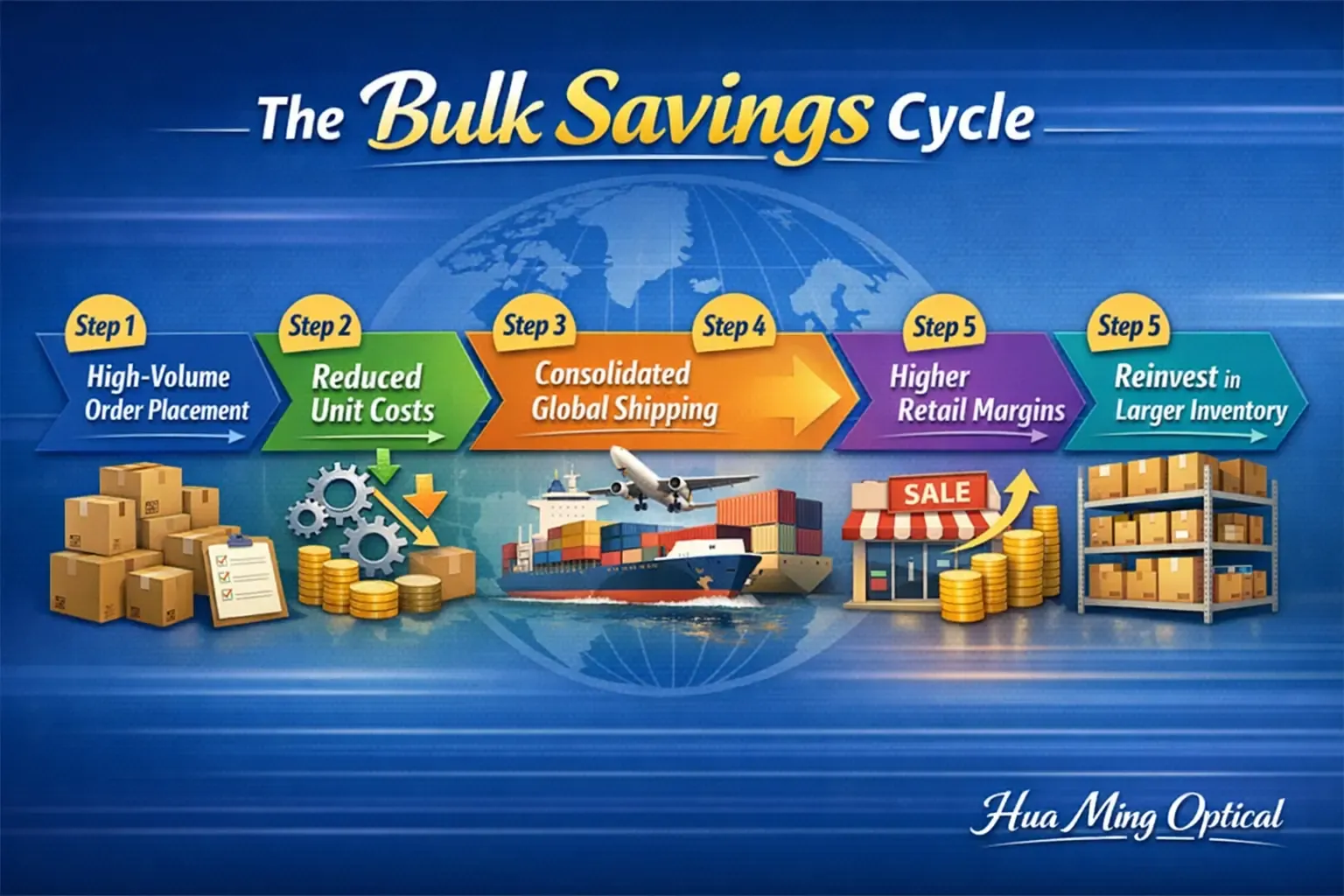
The primary driver for wholesale optical procurement is the margin. When you buy eyeglass frames at wholesale prices, the price per unit often drops significantly as the order volume increases. This "economies of scale" principle means that a business ordering 500 frames pays far less per unit than one ordering 50. These savings are the engine of your business’s net income.
2.2 Maintaining Consistent Inventory Levels to Meet Customer Demand
There is nothing more damaging to a brand than "out of stock" signs. Buying wholesale glasses in bulk ensures that your displays are always full. In the optical world, customers often choose frames based on immediate tactile feedback; if the frame isn't there to be tried on, the sale is lost to a competitor.
2.3 Gaining Access to Exclusive Designs and the Latest Seasonal Trends
Top-tier wholesale optical products are often reserved for bulk buyers. Manufacturers prioritize their large-scale partners when releasing new collections. By establishing a relationship with an optical wholesaler, you gain early access to the latest shapes, colors, and material innovations before they hit the general market.
2.4 Reducing Shipping Overheads per Unit with Consolidated Bulk Orders
Shipping a single frame from an international manufacturer is cost-prohibitive. However, when you import wholesale optical frames in large crates, the shipping, handling, and customs brokerage fees are distributed across hundreds of units. This dramatically reduces the "landed cost" of each item.
3. How and Where to Find High-Quality Eyeglass Frames at Wholesale Prices
Finding the right source requires a blend of digital savvy and traditional networking.
3.1 Leveraging B2B E-commerce Marketplaces for Global Wholesale Access
Digital B2B platforms have revolutionized how wholesale optical eyewear is sourced. These marketplaces allow you to browse thousands of manufacturers from regions like Italy, China, and Japan simultaneously. They provide transparency in pricing and allow for easy comparison of specifications for wholesale optical glasses.
3.2 Navigating Wholesale Directories to Identify Verified Distribution Hubs
Industry-specific directories are goldmines for finding a reliable optical wholesaler. These lists often categorize suppliers by their specialty, whether they focus on luxury brands, budget-friendly options, or specific materials like wholesale acetate eyeglass frames.
3.3 Attending International Optical Trade Fairs for Direct Wholesale Networking
Events like MIDO (Milan) or Vision Expo (New York/Las Vegas) are essential for serious buyers. These fairs allow you to touch the materials, test the hinge tension, and meet the faces behind the brand. It is the best place to find wholesale fashion glasses that haven't even hit the digital catalogs yet.
3.4 Local vs. International Wholesalers: Choosing the Right Source for Your Region
Choosing between a local optical wholesale partner and an international manufacturer involves balancing speed and cost. Local wholesalers offer faster shipping and easier returns, while international factories offer the lowest possible prices for wholesale spectacles.
4. Identifying and Vetting a Reliable Wholesale Partner
Not all suppliers are created equal. Vetting is the most critical step in protecting your investment.
4.1 Evaluating the Wholesaler’s Reputation and Market Credibility
Before committing to wholesale eyeglasses, research the company’s history. How long have they been in business? Do they have a physical presence? A credible wholesaler will have a track record of consistent supply and professional communication.
4.2 Assessing the Breadth and Diversity of the Wholesale Product Catalog
A good partner should offer more than just a few styles. Look for a catalog that covers various "entities" in the optical world: children's frames, sports eyewear, and classic professional styles. This diversity allows you to use a single source for all your eye frames wholesale needs.
4.3 Verifying Quality Compliance Standards (ISO, CE, and FDA Certifications)
Since eyewear is a medical device accessory, compliance is non-negotiable. Ensure the supplier of wholesale frames eyeglasses meets international standards. Buyers working with custom or private-label runs will also want to secure a clear paper trail from the factory, verifying all technical specifications, material safety sheets, and quality certificates before production begins.
- ISO 12870: Specifies fundamental requirements for unglazed spectacle frames.
- CE Mark: Essential for the European market.
- FDA Registration: Required for sales in the United States.
4.4 Checking Wholesale Reviews and Past Buyer Feedback for Reliability
Look for testimonials from other wholesale opticians. Direct feedback regarding shipping delays, product defects, or communication issues can save you from a disastrous partnership. A thorough, step-by-step vetting process is essential to evaluate a supplier's quality control, manufacturing capacity, and delivery reliability before placing a bulk order.
|
Certification |
Region |
Importance |
|
FDA |
USA |
Legal requirement for medical-grade frames. |
|
CE |
Europe |
Ensures health, safety, and environmental protection. |
|
ISO 9001 |
Global |
Quality management system consistency. |
5. Navigating the Wholesale Transaction: Key Terms and Considerations
Understanding the "language of wholesale" is vital for a smooth transaction.
5.1 Understanding Minimum Order Quantities (MOQ) for Wholesale Pricing
The MOQ is the lowest number of units a supplier is willing to sell to maintain wholesale optics pricing. Some factories may require 100 units per style, while others might allow "open stock" where you can mix and match styles to reach a total dollar amount.
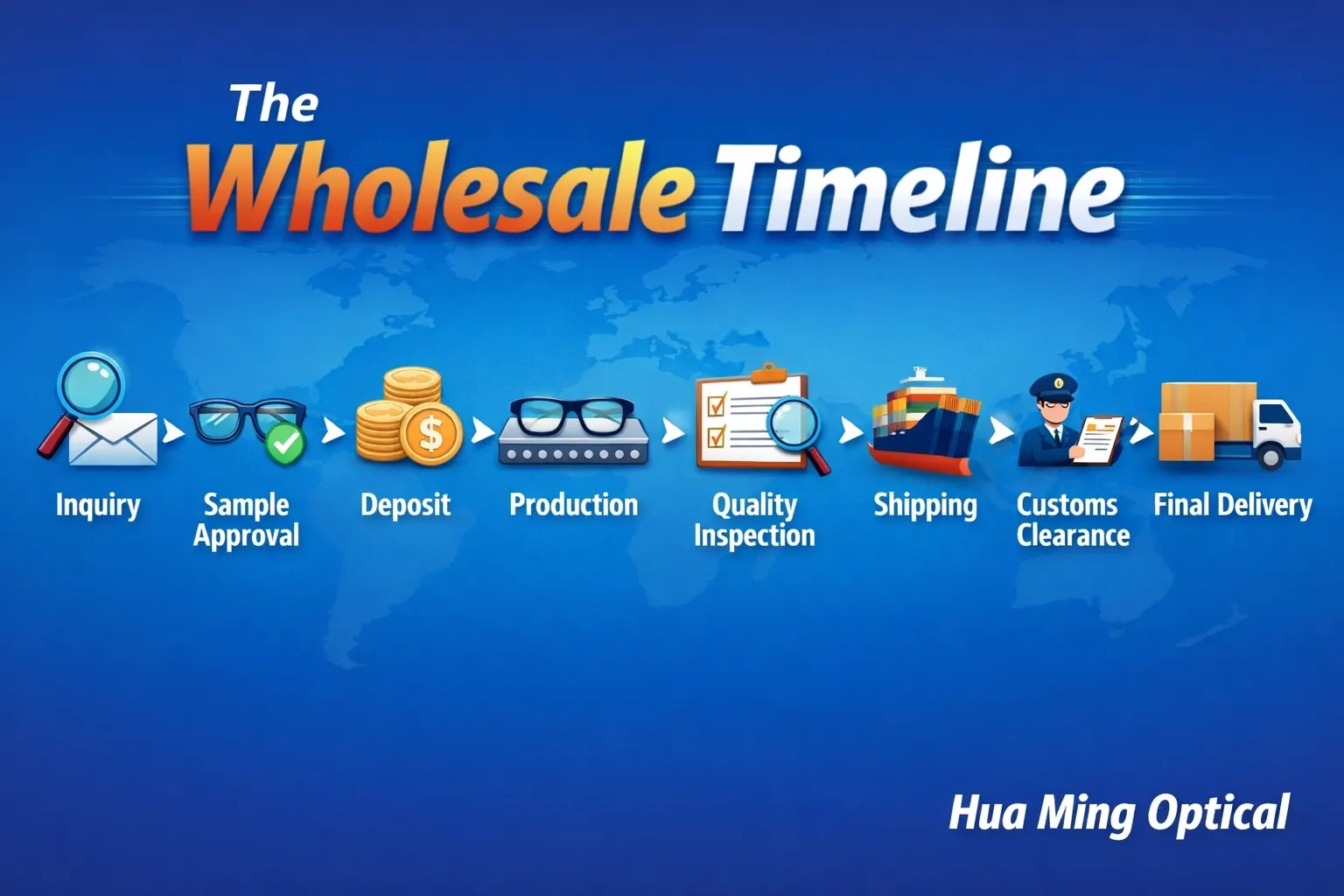
5.2 Analyzing Lead Times: From Order Placement to Warehouse Delivery
When sourcing wholesale glasses frames, timing is everything. Lead time includes production, packaging, and transit. For custom orders, this can be 60-90 days. For ready-to-ship stock, it might be 7-14 days. Proper planning prevents inventory gaps.
5.3 Establishing Secure Payment Terms and Credit Lines in B2B Transactions
Most wholesale optical deals begin with a deposit (e.g., 30% T/T). As your relationship grows, you can negotiate "Net 30" or "Net 60" terms, allowing you to pay for the frames after you have already started selling them to your customers.
5.4 Clarifying Return and Exchange Policies for Defective Bulk Stock
Even the best optical wholesalers occasionally have a batch with defects. Ensure your contract clearly states the process for RMAs (Return Merchandise Authorizations). Who pays for return shipping? Is it a refund or a credit for future eyeglass wholesale orders?
6. Quality Assurance: What to Inspect Before Finalizing a Wholesale Deal
You cannot sell what you do not trust. Quality assurance (QA) is the gatekeeper of your brand's reputation.
6.1 Testing Material Durability: From High-Grade Acetate to Lightweight Titanium
Materials define the price point. When inspecting wholesale acetate frames, look for "hand-polished" finishes and wire-core temples. For metal options, ensure that metal eyeglass frames wholesale batches use nickel-free coatings to prevent skin irritation, a common complaint with low-quality bulk items.
Industry Insights: Selecting the Right Foundations
Selecting the right material is a balance of aesthetics and functionality. For instance, when a retail business partners with a reliable metal eyeglass frames supplier , the focus should always be on the grade of the alloy used. While acetate offers vibrant colors, high-quality metal frames provide a minimalist durability that many professional clients prefer. Finding a dedicated metal eyeglass frames source ensures that your inventory includes lightweight, hypoallergenic options like titanium or stainless steel, which are essential for maintaining a versatile and high-margin collection.
6.2 Evaluating Component Integrity: Hinges, Screws, and Nose Pad Quality
The moving parts are where frames usually fail. Test the "spring hinges" for smoothness. Check if the screws are coated to prevent loosening. High-quality wholesale optical products will use medical-grade silicone for nose pads rather than cheap, hard plastics.
6.3 Ensuring Consistency in Finishing and Color Across Large Batches
In eyewear wholesale, consistency is a sign of a professional factory. If you order 100 "Tortoiseshell" frames, the pattern and hue should be consistent across the entire lot. Significant variations suggest poor quality control during the tumbling or coloring process.
6.4 The Importance of Requesting Pre-Purchase Samples Before Bulk Commitment
Never place a large order without seeing samples. Samples allow you to verify that the wholesale glass frames match the digital photos. It also lets you test the "glazing" process, ensuring that lenses can be fitted easily without the frame cracking or warping.
|
Material |
Key QA Check |
Best For |
|
Cellulose Acetate |
Luster and Flexibility |
High-end fashion, deep colors. |
|
Stainless Steel |
Coating adhesion |
Durability and hypoallergenic needs. |
|
Titanium |
Weight-to-strength ratio |
Premium, lightweight comfort. |
|
TR-90 |
Memory retention |
Sports and children's eyewear. |
6.5 Considering Nylon Frames for Lightweight Flexibility
Beyond acetate and metal, flexible nylon-based polymers have carved out a firm place in the optical supply chain. These materials resist shattering under pressure, snap back into shape after bending, and hold up well in humid or high-activity environments, making them a favorite for wraparound and rimless silhouettes. Retailers stocking active-lifestyle or outdoor-focused customers often find that a well-sourced nylon eyeglass frame collection rounds out their range without adding excess weight to the display case or the customer's face.
6.6 Exploring Screwless Designs for Minimalist, Low-Maintenance Wear
Traditional hinges rely on tiny screws that loosen over time, leading to wobbly temples and repeat repair visits. Riveted pins, interlocking joints, and flexible connectors solve this by removing the screw entirely, resulting in a cleaner profile and far fewer after-sale complaints. For buyers targeting a minimalist, low-maintenance customer base, adding a dependable screwless eyeglass frame line can be a smart way to differentiate a catalog from competitors still relying on conventional hardware.
7. Professional Negotiation Tactics for Savvy Wholesale Buyers
Negotiation in the B2B world is about mutual benefit, not just "beating" the supplier on price.
7.1 How to Negotiate Tiered Pricing Based on Order Volume
Ask for a price list that shows the "break points." For example, the price for wholesale optical frames might drop at 100, 500, and 1,000 units. If you are close to a threshold, it is often worth increasing the order to unlock the lower price tier.
7.2 Discussing Logistics: Who Covers Shipping, Customs, and Insurance?
Don't just look at the unit price; look at the "Incoterms."
- EXW (Ex Works): You pay for everything from the factory door.
- FOB (Free On Board): The supplier gets it to the port; you take over from there.
- DDP (Delivered Duty Paid): The supplier handles everything until it reaches your door. This is often best for new wholesale eyewear buyers.
7.3 Building Long-Term Strategic Partnerships for Better Priority Access
A loyal buyer gets better treatment. If you consistently source your wholesale spectacles from one vendor, they are more likely to offer you flexible payment terms, faster production slots, and first dibs on closeout sales.
7.4 Requesting Customized Wholesale Catalogs Tailored to Your Niche
If your business focuses on a specific demographic, such as petite faces or "alternative fit" bridges, ask your optical wholesaler to curate a selection for you. This saves time and ensures your inventory is highly targeted to your actual customer base. For brands wanting to go a step further, establishing custom manufacturing processes with fully custom molds and tailored branding will help cover your unique requirements from design to final delivery.

8. Common Pitfalls to Avoid When Buying Eyeglass Frames at Wholesale
Even experienced buyers can make mistakes. Recognizing these traps is the first step in avoiding them.
8.1 The Risk of Overstocking Unpopular Designs Without Market Research
The low price of wholesale glasses can be tempting, but 1,000 units of an unpopular frame is just wasted warehouse space. Always balance your "trend" buys with "staple" designs, classic rectangles and round frames that never go out of style.
8.2 Sacrificing Quality for the Lowest Possible Price Point
There is a floor to how cheap wholesale optical glasses can be before the quality becomes a liability. Extremely cheap frames break during lens insertion, leading to "re-do" costs that wipe out your initial savings. Focus on the best value, not the lowest price.
8.3 Ignoring the Fine Print in Wholesale Shipping and Handling Agreements
Hidden fees can destroy your margins. Always check for "document fees," "palletization charges," or "fuel surcharges" that might not be in the initial quote for wholesale optical eyewear.
8.4 Failing to Account for Import Duties and Local Taxes in the Final Cost
When importing wholesale eyeglasses internationally, your local government will likely want a cut. Depending on your country, duties can range from 2% to 20%. Use an online duty calculator or consult a customs broker to ensure your retail price covers these hidden costs.
|
Pitfall |
Consequence |
Prevention |
|
Dead Stock |
Capital tied up in unsellable items. |
Small test batches before large orders. |
|
Hidden Duties |
Unexpected 15-20% cost increase. |
Research HTS codes for eyewear. |
|
Poor Material |
High return rates from customers. |
Strict sample testing (stress tests). |
9. Conclusion: Future-Proofing Your Business with Smart Wholesale Sourcing
Mastering the art of wholesale procurement is a continuous journey of learning and adaptation. As consumer tastes evolve and manufacturing technologies improve, your sourcing strategy must remain agile. By focusing on quality, vetting your partners, and understanding the economic levers of the industry, you position your business to thrive in a competitive landscape.
9.1 A Recap of the Wholesale Buying Checklist
Before you sign off on your next shipment of wholesale optical goods, run through this final check:
- Are the certifications (FDA/CE) current and verified?
- Did the samples pass a durability and glazing test?
- Is the total landed cost (including shipping and duties) within your margin targets?
- Does the mix of styles align with your current sales data?
9.2 Final Thoughts on Maintaining a Competitive Edge in the Optical Market
The future of the optical industry belongs to those who control their supply chain. Whether you are looking for specialized acetate frames to satisfy a boutique crowd or robust metal frames options for a high-traffic retail outlet, the principles remain the same. Transparency, quality, and strategic volume are the pillars of success.
Partner with HUA MING OPTICAL
Ready to elevate your inventory with premium designs and unbeatable value? At HUA MING OPTICAL, we specialize in providing high-quality eyeglass frame collections at wholesale prices that help your business stand out. From the latest trends to timeless classics, our catalog is designed to maximize your profit margins and delight your customers. Contact us today to request our latest wholesale catalog and discover how we can support your growth.
Featured Articles
Inventory procurement is a strategic decision that defines your store's brand positioning and profit margins. For wholesale buyers, understanding the technical differences between acetate and metal frames is essential for inventory optimization. Whether you are stocking metal eyeglass frames wholesale options or high-fashion alternatives, aligning your product mix with 2026 market demands ensures consistent retail sell-through. Understanding Acetate as a B2B Asset Acetate is not standard plastic; it is a premium, plant-based cellulose derivative. For retailers, this material represents high perceived value. Because the color and patterns are embedded within the material sheets rather than painted, the frames offer superior resistance to fading and surface wear, a key selling point for your customers. From an optical technical perspective, cellulose acetate is a thermoplastic. Opticians can utilize heat-adjustment techniques to customize the fit for diverse facial structures. This structural flexibility allows you to carry fewer SKUs while meeting the comfort requirements of a wider customer base. Durability & Benefits of Wholesale Metal Eyeglass Frames Metal frames define the minimalist and professional segment of the eyewear market. Utilizing advanced alloys like titanium and stainless steel, these frames offer a high strength-to-weight ratio and exceptional corrosion resistance. For inventory managers, metal frames provide significant logistical advantages. Their slim profile allows for higher density packing, reducing shipping costs and warehouse footprint. Furthermore, features like adjustable nose pads ensure that metal frames offer a universal fit, making them a reliable staple for high-volume retail environments. Skin Sensitivity: A Return-Rate Risk Buyers Often Overlook Beyond style and cost, material choice directly affects your return and complaint rate. Cellulose acetate is naturally hypoallergenic, which makes it a safe default for sensitive-skin customers. Metal frames are generally safe too, but the risk depends heavily on the alloy: premium titanium and stainless steel are hypoallergenic, while cheaper monel or nickel-based alloys are a common cause of skin irritation and contact dermatitis around the nose and ears. For wholesale buyers, this means the unit cost of a metal frame batch isn't the only variable that matters — the alloy grade determines how many post-sale skin-reaction complaints you can expect. Stocking verified nickel-free or titanium-grade metal frames alongside your acetate range reduces this risk without forcing you to choose one material over the other. Inventory Strategy: Comparison Table for Wholesale Buyers Feature Acetate Frames Metal Frames Material Base Plant-based cellulose Titanium/Stainless Steel alloys Customization Deep, embedded patterns Sleek, minimalist aesthetic Adjustability Thermally adjustable Manual bridge manipulation Shipping Density Lower (requires more space) Higher (compact packaging) Skin Sensitivity Risk Low (naturally hypoallergenic) Varies by alloy grade Primary Market Premium/Fashion-forward Professional/Minimalist Optimizing Your Eyewear Roster for 2026 Success in eyewear retail requires a balanced stock strategy. Acetate is the ideal solution for customers with higher prescription requirements, as the frame's depth effectively conceals lens thickness. Conversely, metal frames cater to active users and those prioritizing lightweight comfort. Expert Insight: Maintaining a 60/40 split between these materials helps mitigate risk and ensures your shelves cater to both fashion-conscious shoppers and professional users, minimizing lost sales due to inventory gaps. Maintenance, Quality, and Long-Term Reliability As a wholesaler, product returns are detrimental to your bottom line. Acetate frames are structurally resilient, allowing for minor adjustments under heat. Metal frames, while durable, require careful inspection of weld points and hinge mechanisms. Regardless of the material, sourcing from manufacturers who prioritize high-quality hinges is essential to extending the product lifecycle. When sourcing your next batch of wholesale acetate eyeglass frames, prioritize those with robust tension-based hinges, as these components determine the longevity of the frame in the hands of the end-user. Which Should You Stock First? If your buyers are fashion-focused boutiques or private-label brands, lead with acetate — its color depth and hypoallergenic profile make it the lower-risk starting point. If your buyers serve professional or high-volume retail environments where shipping density and universal fit matter more, metal frames should anchor your initial order. Most established wholesalers eventually stock both, but starting with the material that matches your primary buyer type reduces early inventory risk. Strategic Sourcing for Sustainable Growth In 2026, building a profitable eyewear business requires a reliable wholesale eyeglass frame supplier who understands market demands. Success depends on partnering with manufacturers who guarantee consistent quality and precise hinge alignment. At Hua Ming Optical, we bridge the gap between high-end manufacturing and wholesale affordability. We ensure every frame meets rigorous standards to keep your returns low and customer satisfaction high. Further Reading Which Types of Acetate Eyeglass Frames Are Best for Wholesale Business? Mazzucchelli vs Chinese Acetate: Which Is Right for Your Wholesale Collection? Are Nylon Frames Better Than Acetate? Complete Guide & Key Reasons
READ FULLFinding a professional metal eyeglass frames supplier is the most critical step for your optical business growth. When you buy optical inventory in bulk, you invest a large amount of capital into products that your retail customers will wear daily on their faces. Metal eyeglass frames require premium base alloys like monel and stainless steel, multi-layer electroplating, precise spring hinge assembly, and perfect surface polishing to satisfy professional opticians and retail buyers. A single oversight in evaluating your eyewear manufacturing partner can lead to severe structural failures like snapping frame bridges, peeling metal coatings, lost retail clients, and permanent damage to your corporate brand reputation. Many global optical buyers make the fundamental mistake of focusing only on the lowest unit price list during their initial factory assessment. However, the wholesale eyewear market contains many unverified trading companies and low-end assembly workshops that use clever digital marketing to hide their operational weaknesses. You need to know exactly how to spot the structural and legal warning signs before you sign any contract or send your financial deposit for custom metal frames. This comprehensive guide details the major industrial red flags you must analyze when evaluating potential partners for your long-term business growth. By learning to identify these factory warning signs early in the negotiation phase, you can protect your capital investment and build a highly secure supply chain for your eyewear lines. Reliable optical manufacturers always maintain completely transparent operations, certified quality standards, and consistent business practices. Let us break down the specific red flags across every department of a wholesale metal eyewear manufacturing operation so you can make a safe and profitable decision. 01. Unverified Business Credentials Every legitimate metal eyewear factory operates under a strict legal framework established by their local government and international trade authorities. When you buy optical frames in bulk, you are establishing a commercial relationship that requires comprehensive legal protection. If a company cannot prove its legal manufacturing existence or corporate business status for optical production, you face an immediate risk of losing your investment. 1.1. No business registration or license proof A legitimate metal eyewear manufacturer will always possess an official business registration certificate and a valid manufacturing license specific to optical goods production. If you ask a supplier for their business license and they make continuous excuses, this is an immediate warning sign. Unverified suppliers often operate illegal, small-scale assembly workshops that do not follow environmental safety standards for chemical metal plating or local labor laws. These underground operations can be shut down by local government authorities at any moment, which means your production order and deposit could disappear instantly. Always verify the official corporate name, registration number, and legal ownership status before you move forward with any business contract. 1.2. Missing company address or factory details Real metal eyewear factories have physical, industrial locations equipped with heavy hydraulic stamping machines, automated wire-bending equipment, CNC milling stations, and specialized polishing lines. A major red flag is when an online supplier only provides a generic mobile phone number or a basic email address without a physical factory street address. If their website only shows a digital contact form and lacks a real physical office or factory location, they are likely a small trading agent operating from a residential apartment. You should always ask for the exact physical address and verify it using satellite maps or independent third-party inspection services. A real manufacturer will gladly share their location and even invite you for a live factory video tour to show their machinery. 1.3. No export/import documentation (for international suppliers) Shipping metal eyeglass frames across international borders requires specific customs paperwork, export licenses, and trade code registrations. If you plan to order metal eyeglass frames wholesale, your supplier must know how to handle international freight documentation smoothly. A supplier who lacks proper export credentials will often ask you to use complicated shipping methods or clear customs under false product descriptions. This lack of legal documentation can cause your shipment to be seized by customs officials at the port of entry, resulting in heavy fines and permanent loss of your cargo. 02. Poor Product Quality Control Metal eyewear requires exceptional structural durability because these products face constant twisting, bending, and human sweat exposure. High-quality frames use premium alloys like monel, high-nickel alloys, stainless steel, or pure titanium with advanced protective layers. If a supplier does not have a strict quality control department, you will receive defective goods that fail in the retail market. 2.1. Inconsistent frame finishing (scratches, uneven coating) The surface electroplating treatment of a metal frame determines its visual beauty and its resistance to skin corrosion. When you inspect a supplier's production lot, the metal surfaces should be perfectly smooth with an even paint or lacquer thickness. A critical red flag is finding minor scratches, tiny air bubbles, or uneven color thickness across different parts of the temple arms or lens rims. Poor electroplating causes the metal color to peel off within weeks of use, which leads to immediate consumer complaints about skin irritation, green discoloration, and allergic reactions. 2.2. Weak metal durability or bending issues Eyeglass frames must maintain their original shape while holding optical lenses under constant tension. If the raw metal material is cheap or improperly heat-treated, the frame rims will warp or bend out of shape under slight manual pressure. Check the spring hinges, bridge welds, and temple wires for structural strength during your technical assessment. Weak base metals or poor soldering points at the bridge and nose pad arms will break easily during lens insertion by opticians or routine adjustments by the end-user. 2.3. No quality inspection reports or QC process A professional factory tracks every stage of production using standardized quality control sheets, tracking materials from raw wire to finished frames. They perform specific stress tests, salt spray tests for corrosion resistance, and hinge cycle tests. If a supplier cannot show you their written quality control manual or recent inspection reports, they simply do not check their products properly. Buying from a supplier without an established inspection process means you are gambling with the quality of your optical inventory. Metal Frame Inspection Type Standard Factory Requirement Red Flag Warning Sign Plating Salt Spray Test Must resist sweat corrosion for over 48 hours Color fades, peels, or rusts quickly Hinge Durability Test Smooth movement past 20,000 continuous cycles Loose screws or broken barrel joints Material Verification Certified titanium or high-grade stainless steel High lead content or cheap scrap metals 03. Unrealistic Pricing While saving money on inventory increases your profit margins, metal eyewear production has fixed baseline costs for raw materials, modern machinery maintenance, and skilled labor. Extreme pricing structures almost always point to hidden problems that will hurt your business later. 3.1. Prices far below market standard without explanation If a supplier offers you a unit price that is significantly lower than every other factory quotation, you must be extremely cautious. Eyewear manufacturing requires expensive metal alloys and precise polishing work. An impossibly low price usually means the supplier is using cheap scrap metals contaminated with lead, or they are skipping the essential protective coating layers. These sub-standard frames will fail quality checks and can cause severe legal liability for your business due to hazardous materials. 3.2. Hidden costs added later in quotation Dishonest suppliers use a classic bait-and-switch strategy to trap buyers. They will give you an incredibly low initial estimate to start the conversation and get your commitment. Once you prepare to place the order, they suddenly add unexpected fees for mold maintenance, export packaging, local logistics, or administrative handling. A trustworthy manufacturing partner will always provide an all-inclusive, transparent quotation right from the beginning of your negotiation. 3.3. No clear breakdown of unit price vs MOQ pricing Mass production relies on economies of scale, meaning the price per unit should drop clearly as the order volume increases. A supplier who refuses to provide a clear pricing tier based on different order quantities is a major red flag. This lack of transparency usually indicates that the supplier is an untrained agent who guesses prices arbitrarily rather than calculating real material costs and factory machine run times. 04. Weak Communication & Responsiveness International business partnerships require clear, fast, and accurate communication to keep production schedules on track. Miscommunications in technical specifications lead directly to manufacturing errors and missed market deadlines. 4.1. Slow reply time to inquiries If a supplier takes several days to reply to a simple email or text message during the sales phase, their communication will only get worse after they receive your deposit. Slow response times indicate that the company is understaffed, disorganized, or does not value your business. When production issues occur or shipping delays happen, you need a partner who responds within hours to solve the problem before it hurts your retail operations. 4.2. Unclear answers about materials or production When you ask specific questions about the type of stainless steel used, the origin of the hinges, or the specific lead time, you should receive direct technical answers. A red flag is when the sales representative gives vague answers like "our quality is the best" or avoids the technical questions completely. This evasion proves that the representative either lacks basic product knowledge or is intentionally hiding the true origin and specifications of their materials. 4.3. No dedicated sales/support contact A reliable wholesale manufacturer assigns a specific account manager or sales engineer to handle your business requirements. If you must talk to a different person every time you call, or if your emails go to a generic, unmonitored public mailbox, your order details will eventually get lost. A lack of dedicated support means the company does not have the infrastructure to manage long-term commercial clients. 05. MOQ & Production Issues Minimum Order Quantity policies reflect a factory's production capacity and setup costs. Unstable or confusing production policies indicate internal operational chaos inside the factory management team. 5.1. No clear minimum order quantity policy Every organized factory knows exactly how many units they must produce in a single machine run to cover their overhead costs. If a supplier tells you that you can order any random quantity without any rules or structure, they are likely not a real manufacturer. They are probably buying leftover stock or factory seconds from various surplus markets, which means you can never re-order the same designs in the future. 5.2. Frequent changes in MOQ after agreement If a supplier agrees to a specific order volume during the negotiation and then suddenly raises the minimum requirement before production starts, you are dealing with an unreliable partner. They use this trick to force you into spending more money after you have already invested time in designing or selecting the styles. Never work with a company that changes agreed business terms arbitrarily. 5.3. Unable to handle custom metal frame requirements The eyewear market moves fast, and retail buyers constantly demand unique designs, specific colors, and custom brand logos. If a factory refuses to adjust minor details or lacks the machinery to handle custom stamping and laser engraving, they cannot support your business growth. A limited production capability means you will always be stuck selling the exact same generic designs as your competitors. 06. Lack of Customization Capability To stand out in the competitive optical market, your brand needs unique style elements and original design features. A supplier who cannot customize products will limit your brand to basic commodities. 6.1. Limited frame design options A real eyewear manufacturer employs an in-house design team that studies global fashion trends and develops new frame shapes every season. If a supplier's catalog only contains a few outdated styles from years ago, they lack innovation and market awareness. Selling old, generic frame shapes makes it impossible for your retail clients to command premium prices in their stores. 6.2. No OEM/ODM support Original Equipment Manufacturing and Original Design Manufacturing capabilities are standard requirements for modern eyewear production. If a factory cannot work from a technical 2D drawing or a 3D digital model, they do not possess modern engineering tools. Without proper development support, you cannot launch exclusive frame collections or protect your unique design ideas from being copied. 6.3. Refusal to modify existing designs Sometimes you only need to change a small detail, like lengthening a temple tip, widening a nose bridge, or changing a color finish. If a supplier reacts with resistance or completely refuses to make these small modifications, their factory tooling is incredibly rigid. This limitation shows they are likely buying pre-made frames from another supplier and cannot actually control the actual manufacturing process. 07. No Sample Policy or Delayed Samples Samples are the ultimate test of a supplier's true product quality, technical accuracy, and operational efficiency before you commit to a large purchase order. 7.1. Refusal to provide samples There is absolutely no valid reason for a wholesale frame manufacturer to refuse a sample request from a serious commercial buyer. If a supplier states that they do not send samples under any circumstances, you should walk away immediately. This refusal is a massive warning sign that they are terrified for you to see the true quality of their materials and construction up close. 7.2. Excessively expensive sample charges While it is normal to pay a reasonable fee for prototypes and shipping, the cost should never be ridiculously inflated. If a supplier demands hundreds of dollars for a single stock metal frame without custom tooling, they are trying to make a quick profit off samples alone. This behavior indicates that they are not interested in a long-term wholesale relationship and are just hunting for small, one-time fees. 7.3. Long delays in sample delivery If a factory takes several weeks or months just to ship out a pair of standard frames from their current stock, their internal logistics are broken. A delay in the sample phase predicts a much larger disaster during full-scale production. If they cannot handle a simple sample shipment efficiently, your main order will likely face massive delays that will ruin your seasonal retail sales. 08. Weak After-Sales Support Your business relationship with a manufacturer does not end when the shipping container leaves the factory loading dock. True business success requires a partner who stands behind their work if things go wrong. 8.1. No warranty or replacement policy Every physical manufacturing process has a small, natural percentage of defects due to machine tolerances or human assembly errors. A professional factory always provides a clear commercial warranty period to cover these rare issues. If a supplier states that all sales are final and refuses to offer any warranty protection, they are leaving you with 100% of the financial risk for any factory mistakes. 8.2. No handling of defective batches If your retail clients start returning frames due to a widespread structural failure like a bad solder point, you need immediate help. An unreliable supplier will ignore your emails, blame your shipping carrier, or claim that your customers broke the frames through improper use. A real partner will immediately investigate the batch number, offer credit notes, or manufacture replacement parts at no extra cost. 8.3. No long-term partnership commitment Unreliable suppliers focus exclusively on the immediate transactional profit of a single invoice. They do not care if your business struggles or succeeds next year. If a supplier exhibits zero interest in learning about your local market, understanding your business goals, or helping you scale your order volume over time, they are a temporary vendor rather than a true strategic partner. Comprehensive Evaluation Framework for Eyewear Sourcing To avoid these dangerous operational traps, you must summarize your assessment criteria into a strict verification workflow. Evaluating potential partners using a structured framework saves your business from costly errors and ensures a stable inventory flow. Verify Legal Registration: Always request a copy of the official business license and check the factory address through physical inspection or independent local agencies. Audit Technical Testing: Demand to see recent material certificates and laboratory test reports for plating durability and metal composition. Evaluate Communication Speed: Track how fast the sales team answers technical product questions during your initial negotiation weeks. Inspect Prototype Quality: Never skip the sample phase; examine the finishing under a magnifying lens to check for plating flaws or weak solder joints. Confirm After-Sales Written Terms: Ensure that the final commercial contract explicitly defines the replacement policy for defective components before you pay the deposit. Elevating Your Brand with Secure Sourcing Choosing a manufacturing partner requires balancing cost efficiency with strict quality standards to protect your brand asset. Avoiding suppliers who exhibit unverified credentials, weak quality control, or poor communication ensures your inventory remains excellent. A beautiful, durable metal frame creates a happy end-consumer who will remain loyal to your optical brand for many years. When you partner with an established industry leader that values transparent communication, you secure your entire supply chain. A professional factory provides the engineering expertise, advanced materials, and reliable delivery times you need to beat your competitors. Invest time in checking for red flags early so you can build a highly profitable, stress-free wholesale business. Partner with a Trusted Industry Leader If you want to secure your supply chain and protect your optical business from these common production risks, you need an experienced manufacturing partner that prioritizes quality control and transparent business practices. Hua Ming Optical provides premium OEM and ODM wholesale eyeglass frame production solutions with verified material certifications and dedicated technical support for global eyewear brands. Contact our engineering team today to review your custom design specifications and order your initial quality evaluation samples.
READ FULLEvery buyer looking for reliable wholesale acetate eyeglass frames solutions faces the same sourcing decision at some point: do you specify Italian Mazzucchelli acetate, or do you work with Chinese domestic acetate? The material you choose affects your production cost, your retail price point, your brand positioning, and ultimately your customer satisfaction rate. This guide breaks down the real differences between these two acetate sources so you can make a confident decision for your next bulk order. Understanding the distinction between these materials is not just a technical exercise. It is a business decision that shapes the kind of optical brand you are building. A boutique luxury line has different material needs than a high-volume wholesale catalog. Both options have legitimate strengths, and the right answer depends entirely on who your customers are and what margin structure your business requires. What Is Mazzucchelli Acetate? Mazzucchelli is an Italian company based in Castiglione Olona that has been producing cellulose acetate sheets since 1849. Their material is widely regarded as the benchmark for premium acetate in the global eyewear industry. When luxury brands like Oliver Peoples, Persol, or Lindberg specify Italian acetate, they are most often referring to Mazzucchelli sheets. The production process at Mazzucchelli uses a solvent casting method where cellulose acetate flakes are dissolved, pigmented, and cast into large sheets over extended drying periods. This slow manufacturing process creates a material with exceptional optical clarity, deep color saturation, and highly consistent physical properties across every sheet produced. The result is an acetate that polishes to a mirror-like surface finish and maintains its structural integrity and color depth over many years of daily wear. For wholesale buyers, Mazzucchelli acetate communicates a clear brand signal. When your retail clients see "Italian acetate" on your product specification sheet, it immediately positions your frames in the premium category. This material justifies higher retail price points and supports the kind of brand storytelling that resonates with fashion-conscious optical store owners and their customers. What Is Chinese Domestic Acetate? Chinese domestic acetate refers to cellulose acetate sheets produced by manufacturers within China. Over the past two decades, the quality of Chinese acetate production has improved substantially. Major Chinese acetate producers now supply reliable material that meets the functional requirements of the global optical market at a significantly lower cost per sheet than Italian alternatives. Chinese domestic acetate is available in a wide range of colors, patterns, and thicknesses. For standard collections targeting mid-range optical retailers, everyday fashion stores, and corporate eyewear programs, Chinese acetate delivers consistent performance at a price point that allows competitive pricing without sacrificing basic quality standards. Working with a professional acetate eyeglass frame supplier who has established relationships with reliable Chinese acetate producers helps manage material consistency across large production batches. The key advantage of Chinese domestic acetate is not just lower material cost. It also means shorter lead times on custom colors and patterns because the acetate source and the frame factory are often in close geographic proximity. When you need a specific Pantone color match for a private label collection on a tight timeline, working with domestic Chinese acetate gives your supplier much faster turnaround on material procurement. Direct Comparison: What Actually Differs Between the Two? Color Depth and Optical Clarity This is where Mazzucchelli holds its clearest advantage. The solvent casting process produces color layers with greater depth and dimensional richness than most Chinese domestic alternatives. When you look at a tortoiseshell pattern in Mazzucchelli acetate, the amber, brown, and black tones appear to exist inside the material at different depths, creating a three-dimensional visual effect. Standard Chinese domestic acetate often produces a flatter, more surface-level color appearance in direct comparison. For crystal and transparent acetate frames, this difference is most visible. Mazzucchelli transparent acetate has a water-clear optical quality with no yellow tint. Chinese domestic transparent acetate varies by producer, with some manufacturers matching this clarity closely and others showing a slight haze or warm undertone in the finished frame. Surface Polish Quality Both material types respond well to mechanical and hand polishing. However, Mazzucchelli acetate achieves a higher peak gloss level due to its denser molecular structure. Frames made from Mazzucchelli sheets maintain their polish longer under daily wear conditions, with less surface micro-scratching visible over a 12 to 24 month period compared to lower-grade domestic alternatives. For wholesale buyers sourcing frames for premium optical retailers where customers expect a luxury feel in the hand, this polishing difference is noticeable during in-store handling. For buyers sourcing everyday fashion frames where customers prioritize style and value over long-term material performance, the polishing difference becomes less commercially significant. Consistency Across Production Batches Mazzucchelli maintains very tight quality control over their sheet production, which translates into exceptional color and property consistency across large production batches. When you order 500 frames in a specific Mazzucchelli tortoiseshell code, every frame in that batch will have an indistinguishable pattern match. Chinese domestic acetate consistency varies by producer. Top-tier Chinese acetate manufacturers have significantly closed this gap in recent years, but batch-to-batch variation in color matching remains a more common concern when working with domestic Chinese material at lower price tiers. Specifying a reliable Chinese acetate producer by name in your purchase order helps manage this risk effectively. Cost Difference for Wholesale Buyers Mazzucchelli acetate sheets cost significantly more per kilogram than Chinese domestic alternatives. This material cost difference flows through to your per-frame production cost. For a standard acetate optical frame, specifying Mazzucchelli material typically adds a meaningful premium to the unit cost compared to Chinese domestic acetate at equivalent thickness and color specifications. For brands selling at premium retail price points above $150 per frame, this material cost premium is easily absorbed into the margin structure. For brands selling wholesale at $8 to $20 per frame to volume retailers, the material cost difference directly impacts competitiveness and needs careful evaluation against the brand positioning benefits. Which Acetate Is Right for Your Business? Choose Mazzucchelli When: Your retail price points are above $100 per frame and your customers expect premium materials You are building a private label collection that competes with established fashion eyewear brands Your retail partners are independent boutiques, designer optical stores, or department store optical departments where material provenance matters in the sales conversation You want to use "Italian acetate" as a marketing claim in your product descriptions and catalog copy Color depth and long-term surface quality are more important than unit cost optimization Choose Chinese Domestic Acetate When: Your wholesale price targets require tight material cost control to maintain competitive margins You are sourcing for high-volume optical retail chains where price competitiveness is the primary purchase driver You need rapid turnaround on custom colors or patterns with shorter material procurement lead times Your collection targets everyday fashion eyewear rather than premium optical positioning You are sourcing promotional or corporate eyewear where functional performance matters more than prestige material credentials The Hybrid Approach Many successful wholesale buyers use both materials across their catalog. They specify Mazzucchelli acetate for their signature collection or hero styles where premium positioning justifies the material investment, and work with reliable Chinese domestic acetate for their volume lines and entry-level wholesale offerings. This hybrid approach allows a single brand to serve multiple retail segments without forcing a binary choice between quality and cost competitiveness. 💡 Rounding Out Your Wholesale Catalog If your buyers also ask for lightweight, sports-ready options alongside acetate, our nylon eyeglass frame collection offers a durable, flexible alternative suited for active lifestyle and performance-focused retail segments. Questions to Ask Your Supplier Before Specifying Acetate Material Regardless of which acetate direction you choose, asking the right questions of your frame supplier protects your brand from material substitution and quality inconsistencies in production. Before finalizing your material specification, confirm the following with your manufacturing partner: Can you provide the acetate material origin certificate or supplier documentation for my order? Which specific Chinese acetate producer do you source from, and can I see their material specification sheet? What quality control checks do you perform on incoming acetate sheets before cutting? How do you handle color matching across large production batches to ensure consistency? Can I request Mazzucchelli material on selected styles within a mixed order? A reliable manufacturing partner will answer these questions clearly and provide supporting documentation. Transparency about material sourcing is one of the clearest indicators that a supplier maintains genuine quality standards across their production process. If you are at an early stage in evaluating suppliers, our guide on what to check before sourcing eyeglass frames from a wholesale supplier covers the full vetting process in detail. Making the Right Material Decision for Your Brand The Mazzucchelli vs Chinese acetate decision is ultimately a brand positioning decision as much as a material selection. Both produce quality eyeglass frames when processed by skilled manufacturers with proper quality control. The difference lies in the level of premium positioning, the visual depth of the finished product, and the story you can tell your retail partners about what makes your frames worth their price point. If you are building a brand that competes on design and material quality, Italian acetate gives you a genuine differentiator that resonates with discerning optical buyers. If you are building a brand that competes on value, variety, and margin efficiency for your retail partners, well-sourced Chinese domestic acetate delivers the performance your customers need at a cost structure that supports competitive pricing. Contact Hua Ming Optical to discuss your next collection and request material samples from both options before committing to your production specification. Further Reading Which Types of Acetate Eyeglass Frames Are Best for Wholesale Business? Which Eyeglass Frames Are Better for Wholesale Buyers: Acetate or Metal Frames? Are Nylon Frames Better Than Acetate? Complete Guide & Key Reasons
READ FULL