



.png)

How to Evaluate Wholesale Eyeglass Frames Made from Nylon Before Bulk Purchase
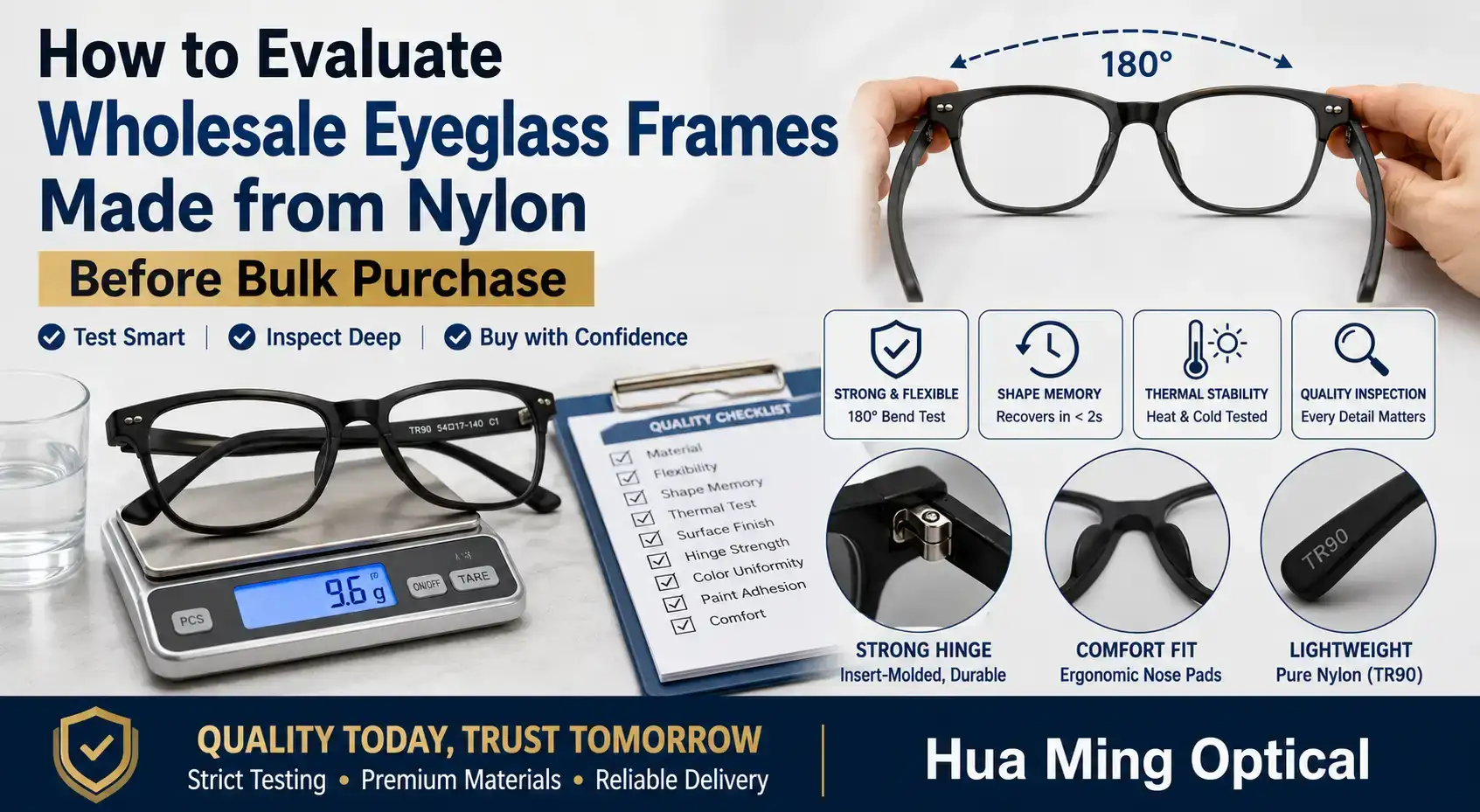
Buying wholesale eyewear stock requires a deep understanding of product quality. Many global retail buyers, optical shop owners, and corporate distributors prefer nylon frames. This raw plastic material is famous for its light weight and structural flexibility. However, factories around the world produce different levels of quality. If a business owner imports a bad batch of glasses, the retail returns will rise. This issue hurts your business profit and damages your brand name among consumers. Therefore, a professional importer must know how to check the material quality before signing a factory purchase contract. Sourcing managers can run easy tests on sample pairs to find small manufacturing defects.
When you source high volumes, you need to understand the true value of a nylon eyeglass frame to avoid cheap plastic items. Low-grade factories often mix cheap recycled plastic with nylon resin to reduce production costs. This bad practice creates frames that break easily under small amounts of physical pressure. A high-quality nylon frame must use clean polyamide raw materials. Sourcing agents should inspect the physical strength, chemical safety, and frame balance during the sampling phase. This guide provides clear steps to test nylon optical goods using easy factory methods. By following these quality checks, business buyers can secure their financial investments and maintain good stock standards.
01. Introduction to Nylon Eyewear Evaluation
Evaluating optical stock before sending a big money deposit helps protect your local distribution company. Nylon eyewear uses advanced plastic technology to deliver great comfort to the end consumer. Still, every optical production plant uses different raw material mixtures, molding machinery, and cooling speeds. A retail shop owner should never buy wholesale stock based only on online catalog pictures. Sourcing managers need to ask for physical samples to check the mechanical strength of the product. This inspection helps you find hidden plastic cracks, weak metal joints, and bad paint finishes.
The global optical market classifies high-quality nylon as an engineering plastic with shape memory properties. This chemical feature allows the glasses to bend under pressure and return to their proper alignment. If the factory uses poor quality raw materials, the glasses will warp permanently or snap under sunlight. Professional buyers must use a step-by-step audit plan to look at the plastic surface, test the moving joints, and measure the weight. These quality control steps reduce your business risks when dealing with international manufacturing suppliers.
02. Understanding the Raw Material Chemistry
2.1. Polyamide Resins and TR90 Quality Standards
Nylon eyewear belongs to a specific chemical family called transparent polyamides. In the global optical market, high-quality nylon is famously known as TR90 or Grilamid plastic material. This chemical resin does not contain harmful chemical softeners like plasticizers. The absence of these softeners makes the material highly biocompatible, meaning it will not cause allergic skin rashes on the face of the wearer.
When you look at factory test sheets, you should check the grade of the polyamide material. Clean polyamide resin gives the frames a high level of impact resistance. This structural feature allows the glasses to absorb physical shocks without splitting open. Cheap factories often mix scrap acrylic or polycarbonate into the injection machinery. This bad mixing ruins the chemical bond, which makes the final glasses brittle and dangerous for active sports users.
2.2. Checking the Density of Nylon Grilamid Plastic
Pure polyamide resin has a very low specific gravity value, which sits between 1.00 and 1.14 grams per cubic centimeter. This scientific number means that genuine nylon is lighter than traditional cellulose acetate and standard polycarbonate. Sourcing agents can check this physical feature by using a digital micro-scale in their office.
A standard optical frame made from pure nylon should weigh between 7 grams and 12 grams without any demo lenses. If your sample frame weighs more than 15 grams, the factory has likely mixed in heavy industrial fillers. Heavy frames press down on the nose bridge and behind the ears, causing physical discomfort for the retail consumer. True nylon frames can even float on top of water if they do not contain heavy metal hinges inside the plastic body.
03. Physical Tests to Perform on Nylon Frame Samples
3.1. The 180-Degree Flex and Bend Test
The most important feature of nylon eyewear is its ability to flex without breaking into two pieces. To test this structural feature, an optical buyer should perform a physical bending test on the sample frame. Hold the front section of the frame firmly with both hands and pull the temple arms outward in a straight line.
High-quality polyamide frames can open up to a flat 180-degree angle without cracking at the center bridge. During this test, you must look closely at the plastic surface near the nose area. If the material shows tiny white stress lines, the plastic lacks true flexibility. These white lines mean the internal molecular structure is tearing apart, and the frame will snap after a few weeks of customer use.
3.2. Measuring the Shape Memory Recovery Time
Shape memory means the frame remembers its original structural design after someone bends it out of shape. After you finish the 180-degree flex test, you must release the temple arms immediately to observe the reaction.
A high-grade nylon frame will snap back into its correct geometric shape in less than two seconds. The distance between the two temple tips must match the original measurements exactly. If the frame stays wide open, twists to one side, or takes a long time to recover, the material lacks elastic memory. This defect means the glasses will become loose on the head of the user over time, leading to constant slipping complaints.
3.3. Thermal Stress Test in High Temperatures
Nylon eyewear must survive high heat conditions without losing its shape, especially when stored inside a closed car during summer days. Cheap plastics soften quickly under heat, which makes the rims lose their grip on the prescription lenses. Sourcing managers can test this by placing the sample frame into a warm water bath heated to 60 degrees Celsius for three minutes.
After you take the frame out of the warm water, try to twist the lens rims gently. A premium nylon frame will keep its rigidity and structural shape perfectly. If the plastic feels soft like rubber, warps out of shape, or feels sticky to the touch, the material lacks thermal stabilizers. This low quality will cause the frame to deform when retail optical shops try to insert hot prescription lenses using standard frame warmers.
3.4. Cold Weather Impact and Crack Resistance
Extreme cold weather makes low-grade plastics brittle, which causes the frames to shatter when dropped onto hard floors. High-quality nylon keeps its impact resistance even when the temperature drops below freezing. You can test this environmental survival feature by placing a frame sample inside a standard freezer at minus 10 degrees Celsius for two hours.
Take the cold frame out of the freezer and drop it from a height of five feet onto a concrete floor. A high-quality polyamide frame will bounce off the floor without sustaining any physical damage. If the rim cracks, chips, or breaks at the hinge section, the factory did not add proper cold-weather impact modifiers to the plastic resin mix.
04. Quick Sample Checks Before You Commit to a Bulk Order
Before a sample ever reaches your test bench, a few seconds of visual and tactile inspection can already tell you a lot about how a factory runs its production line. These checks are less about formal pass/fail criteria and more about reading the overall reliability of the supplier you are about to commit to.
Run a fingertip along the inner rim edges and temple tips. A clean, burr-free surface signals that the factory tumbles and polishes its parts properly instead of skipping that step to save time. Next, hold the sample under a bright light and look at the outer edge of the rim for a raised seam, known as mold flash. A near-invisible seam means the factory maintains its injection molds well; a rough, visible ridge suggests aging equipment that will likely produce inconsistent batches once volume scales up. For colored or transparent samples, check the plastic under strong light for uneven streaks, trapped bubbles, or cloudy patches, which usually point to poor clean-room discipline during injection.
None of these are deal-breakers on their own, but a sample with several of these small issues is a preview of what an entire bulk shipment could look like once you have already paid a deposit.
05. Evaluating Hardware and Component Assembly
5.1. Checking Injected Hinge Strength and Screws
Nylon plastic cannot be dissolved by standard optical glues or acetone solvents, which means workers cannot repair it easily if it breaks. Therefore, the metal hinges must be attached to the plastic frame using high-strength mechanical methods. Look at the inner joint where the temple arm connects to the front rim to see the assembly method.
Premium factories use an insert-molding process, which embeds the metal hinge deep inside the liquid plastic while the frame is forming. You must avoid cheap frames where the factory uses simple industrial glue to stick the metal hinge into a pre-drilled slot. Glued hinges will pull out of the plastic frame after a few weeks of regular use. The connection screw should also fit tightly inside the metal thread without any loose shaking.
5.2. Assessing Nose Pad Ergonomics and Comfort
Because wholesale eyeglass frames nylon products are molded as a single plastic piece, the nose pads are usually part of the front rim design. The angle and width of these nose pads determine how well the glasses balance on a human face.
The plastic pads must have a wide, smooth surface area to spread the weight of the glasses evenly across the nose bridge. If the nose pads are too narrow or have sharp molded ridges, they will dig into the skin and cause red marks. For international markets, you should verify that the nose pad height matches the facial structure of your target consumers to prevent the frames from sliding down constantly.
06. Chemical Resistance and Surface Coating Durability
6.1. The Isopropyl Alcohol Rub Test for Paint Quality
Many nylon glasses receive an extra spray coating of matte or glossy paint to create beautiful fashion finishes. If the factory does not use compatible polyurethane paints, the color layer will peel off like old skin. Importers can run an easy chemical rub test to verify the paint grip.
Soak a clean microfiber cloth in 70 percent isopropyl alcohol solution. Rub the surface of the painted frame firmly back and forth twenty times in a single spot. Check both the cloth and the frame surface immediately. If the paint pigment bleeds onto the cloth or the frame finish turns cloudy, the paint quality is low. High-quality frames use specialized primers that bond the color permanently to the slick nylon surface.
6.2. Sweat Resistance and Sweat Anti-Corrosion Testing
Eyewear stays in constant contact with human skin, absorbing facial oils, sweat, and hair sprays daily. Cheap plastic frames react to human sweat by turning yellow, losing their gloss, or developing white crusty spots.
Professional testing laboratories check this by submerging the frame sample into a mild salty acid solution that mimics human sweat for twenty-four hours. For an office test, you can rub a mix of warm water and table salt onto the inner temple arm and leave it overnight. The next morning, wash the frame and inspect the surface. The plastic must retain its original smooth shine without any bubbling, skin peeling, or chemical discoloration.
07. Factory Compliance and Supplier Vetting
7.1. ISO 12870 Testing Standards for Eyewear
When you import large volumes of optical products across international borders, customs offices require official safety documents. Reliable eyewear factories run their products through international standard tests, specifically the ISO 12870 standard. This international compliance rule covers frame dimensions, mechanical stability, heat resistance, and biocompatibility.
Before you send any money transfer to a wholesale supplier, ask their sales team for certified copies of their ISO test reports. A professional manufacturer will share these documents quickly to prove their product quality. If a supplier makes excuses or refuses to share their testing certificates, they are likely selling low-quality stock from small uncertified workshops.
7.2. Evaluating Supplier Responsiveness and Sample Negotiation
How a factory handles the sample stage often predicts how it will handle your actual bulk order. Before committing to a purchase contract, pay attention to a few business-side signals that have nothing to do with the plastic itself.
Ask for a firm sample lead time and compare it against what the factory actually delivers. A supplier that misses its own sample deadline by weeks is unlikely to hit production deadlines on a much larger order. Request a written quote that separates sample cost, tooling or mold fees if custom designs are involved, minimum order quantity, and per-unit pricing at different volume tiers, then compare this structure across two or three suppliers rather than relying on price alone. Vague or shifting numbers from one conversation to the next are a warning sign.
It also helps to ask direct technical questions, such as the exact polyamide grade used or the hinge assembly method, before the sample even arrives. A factory that answers clearly and consistently across separate conversations is generally more trustworthy than one that gives generic marketing answers or contradicts itself between messages.
Sourcing Quality Benchmark Data
|
Technical Sourcing Metric |
High-Grade Nylon Benchmark |
Low-Grade Plastic Warning |
|
Material Base |
Pure Polyamide Resin (TR90) |
Mixed Polycarbonate / Acrylic |
|
Frame Weight (No Lenses) |
7 grams to 12 grams |
16 grams or higher |
|
180-Degree Flex Test |
Bends completely with zero damage |
Snaps or shows white stress marks |
|
Shape Recovery Time |
Under 2 seconds |
Stays warped or recovers slowly |
|
Hinge Assembly Method |
Molded directly into the plastic |
Attached with cheap surface glue |
|
Alcohol Rub Resistance |
No color transfer or surface cloudiness |
Paint peels or bleeds onto cloth |
08. Summary of Sourcing Guidelines
Evaluating wholesale nylon eyewear requires a methodical approach that prioritizes physical testing over simple visual admiration. Importers must remember that true nylon products deliver specific benefits, including shape memory, ultra-low weight, and high chemical safety. By conducting physical flex tests, buyers can easily separate premium polyamide frames from cheap, brittle plastic imitations. Checking the factory injection points and surface coatings ensures that your retail inventory looks premium and satisfies consumer expectations.
Furthermore, analyzing the assembly of small metal components like hinges and screws prevents premature breakage at common failure points. Verifying factory compliance certificates and reading supplier responsiveness during the sample stage protects your business investment before you ever place a bulk order. A successful B2B sourcing strategy relies on building tight quality control steps during the initial sample phase. Spending time to test samples carefully before placing large bulk orders protects your commercial capital and builds long-term market trust.
09. Sourcing Premium Wholesale Eyeglass Frames
Building a highly profitable eyewear brand requires a dependable manufacturing partner who understands international quality standards. If your distribution company wants to import high-performance optical stock, our production team is ready to serve your commercial needs. We focus on high-precision injection molding, using clean polyamide resins to manufacture durable goods that pass strict international quality audits. Our factory maintains rigorous internal checks to ensure every batch delivers consistent colors, smooth surface finishes, and long-lasting mechanical hardware joints.
At Hua Ming Optical, we help global distributors build strong retail portfolios by offering extensive customization services and certified manufacturing reliability. When you cooperate with our team to secure your next wholesale eyeglass frame shipment, you receive complete access to detailed material datasheets and protective bulk packaging designs. Our specialized sales staff can guide you through low minimum order quantities, custom logo printing options, and clear shipping timelines tailored to your local market requirements. Send us your query today to request fresh product catalogs and physical sample pairs for your next product review.
Explore More Nylon Frames Blogs
Featured Articles
Inventory procurement is a strategic decision that defines your store's brand positioning and profit margins. For wholesale buyers, understanding the technical differences between acetate and metal frames is essential for inventory optimization. Whether you are stocking metal eyeglass frames wholesale options or high-fashion alternatives, aligning your product mix with 2026 market demands ensures consistent retail sell-through. Understanding Acetate as a B2B Asset Acetate is not standard plastic; it is a premium, plant-based cellulose derivative. For retailers, this material represents high perceived value. Because the color and patterns are embedded within the material sheets rather than painted, the frames offer superior resistance to fading and surface wear, a key selling point for your customers. From an optical technical perspective, cellulose acetate is a thermoplastic. Opticians can utilize heat-adjustment techniques to customize the fit for diverse facial structures. This structural flexibility allows you to carry fewer SKUs while meeting the comfort requirements of a wider customer base. Durability & Benefits of Wholesale Metal Eyeglass Frames Metal frames define the minimalist and professional segment of the eyewear market. Utilizing advanced alloys like titanium and stainless steel, these frames offer a high strength-to-weight ratio and exceptional corrosion resistance. For inventory managers, metal frames provide significant logistical advantages. Their slim profile allows for higher density packing, reducing shipping costs and warehouse footprint. Furthermore, features like adjustable nose pads ensure that metal frames offer a universal fit, making them a reliable staple for high-volume retail environments. Skin Sensitivity: A Return-Rate Risk Buyers Often Overlook Beyond style and cost, material choice directly affects your return and complaint rate. Cellulose acetate is naturally hypoallergenic, which makes it a safe default for sensitive-skin customers. Metal frames are generally safe too, but the risk depends heavily on the alloy: premium titanium and stainless steel are hypoallergenic, while cheaper monel or nickel-based alloys are a common cause of skin irritation and contact dermatitis around the nose and ears. For wholesale buyers, this means the unit cost of a metal frame batch isn't the only variable that matters — the alloy grade determines how many post-sale skin-reaction complaints you can expect. Stocking verified nickel-free or titanium-grade metal frames alongside your acetate range reduces this risk without forcing you to choose one material over the other. Inventory Strategy: Comparison Table for Wholesale Buyers Feature Acetate Frames Metal Frames Material Base Plant-based cellulose Titanium/Stainless Steel alloys Customization Deep, embedded patterns Sleek, minimalist aesthetic Adjustability Thermally adjustable Manual bridge manipulation Shipping Density Lower (requires more space) Higher (compact packaging) Skin Sensitivity Risk Low (naturally hypoallergenic) Varies by alloy grade Primary Market Premium/Fashion-forward Professional/Minimalist Optimizing Your Eyewear Roster for 2026 Success in eyewear retail requires a balanced stock strategy. Acetate is the ideal solution for customers with higher prescription requirements, as the frame's depth effectively conceals lens thickness. Conversely, metal frames cater to active users and those prioritizing lightweight comfort. Expert Insight: Maintaining a 60/40 split between these materials helps mitigate risk and ensures your shelves cater to both fashion-conscious shoppers and professional users, minimizing lost sales due to inventory gaps. Maintenance, Quality, and Long-Term Reliability As a wholesaler, product returns are detrimental to your bottom line. Acetate frames are structurally resilient, allowing for minor adjustments under heat. Metal frames, while durable, require careful inspection of weld points and hinge mechanisms. Regardless of the material, sourcing from manufacturers who prioritize high-quality hinges is essential to extending the product lifecycle. When sourcing your next batch of wholesale acetate eyeglass frames, prioritize those with robust tension-based hinges, as these components determine the longevity of the frame in the hands of the end-user. Which Should You Stock First? If your buyers are fashion-focused boutiques or private-label brands, lead with acetate — its color depth and hypoallergenic profile make it the lower-risk starting point. If your buyers serve professional or high-volume retail environments where shipping density and universal fit matter more, metal frames should anchor your initial order. Most established wholesalers eventually stock both, but starting with the material that matches your primary buyer type reduces early inventory risk. Strategic Sourcing for Sustainable Growth In 2026, building a profitable eyewear business requires a reliable wholesale eyeglass frame supplier who understands market demands. Success depends on partnering with manufacturers who guarantee consistent quality and precise hinge alignment. At Hua Ming Optical, we bridge the gap between high-end manufacturing and wholesale affordability. We ensure every frame meets rigorous standards to keep your returns low and customer satisfaction high. Further Reading Which Types of Acetate Eyeglass Frames Are Best for Wholesale Business? Mazzucchelli vs Chinese Acetate: Which Is Right for Your Wholesale Collection? Are Nylon Frames Better Than Acetate? Complete Guide & Key Reasons
READ FULLFinding a professional metal eyeglass frames supplier is the most critical step for your optical business growth. When you buy optical inventory in bulk, you invest a large amount of capital into products that your retail customers will wear daily on their faces. Metal eyeglass frames require premium base alloys like monel and stainless steel, multi-layer electroplating, precise spring hinge assembly, and perfect surface polishing to satisfy professional opticians and retail buyers. A single oversight in evaluating your eyewear manufacturing partner can lead to severe structural failures like snapping frame bridges, peeling metal coatings, lost retail clients, and permanent damage to your corporate brand reputation. Many global optical buyers make the fundamental mistake of focusing only on the lowest unit price list during their initial factory assessment. However, the wholesale eyewear market contains many unverified trading companies and low-end assembly workshops that use clever digital marketing to hide their operational weaknesses. You need to know exactly how to spot the structural and legal warning signs before you sign any contract or send your financial deposit for custom metal frames. This comprehensive guide details the major industrial red flags you must analyze when evaluating potential partners for your long-term business growth. By learning to identify these factory warning signs early in the negotiation phase, you can protect your capital investment and build a highly secure supply chain for your eyewear lines. Reliable optical manufacturers always maintain completely transparent operations, certified quality standards, and consistent business practices. Let us break down the specific red flags across every department of a wholesale metal eyewear manufacturing operation so you can make a safe and profitable decision. 01. Unverified Business Credentials Every legitimate metal eyewear factory operates under a strict legal framework established by their local government and international trade authorities. When you buy optical frames in bulk, you are establishing a commercial relationship that requires comprehensive legal protection. If a company cannot prove its legal manufacturing existence or corporate business status for optical production, you face an immediate risk of losing your investment. 1.1. No business registration or license proof A legitimate metal eyewear manufacturer will always possess an official business registration certificate and a valid manufacturing license specific to optical goods production. If you ask a supplier for their business license and they make continuous excuses, this is an immediate warning sign. Unverified suppliers often operate illegal, small-scale assembly workshops that do not follow environmental safety standards for chemical metal plating or local labor laws. These underground operations can be shut down by local government authorities at any moment, which means your production order and deposit could disappear instantly. Always verify the official corporate name, registration number, and legal ownership status before you move forward with any business contract. 1.2. Missing company address or factory details Real metal eyewear factories have physical, industrial locations equipped with heavy hydraulic stamping machines, automated wire-bending equipment, CNC milling stations, and specialized polishing lines. A major red flag is when an online supplier only provides a generic mobile phone number or a basic email address without a physical factory street address. If their website only shows a digital contact form and lacks a real physical office or factory location, they are likely a small trading agent operating from a residential apartment. You should always ask for the exact physical address and verify it using satellite maps or independent third-party inspection services. A real manufacturer will gladly share their location and even invite you for a live factory video tour to show their machinery. 1.3. No export/import documentation (for international suppliers) Shipping metal eyeglass frames across international borders requires specific customs paperwork, export licenses, and trade code registrations. If you plan to order metal eyeglass frames wholesale, your supplier must know how to handle international freight documentation smoothly. A supplier who lacks proper export credentials will often ask you to use complicated shipping methods or clear customs under false product descriptions. This lack of legal documentation can cause your shipment to be seized by customs officials at the port of entry, resulting in heavy fines and permanent loss of your cargo. 02. Poor Product Quality Control Metal eyewear requires exceptional structural durability because these products face constant twisting, bending, and human sweat exposure. High-quality frames use premium alloys like monel, high-nickel alloys, stainless steel, or pure titanium with advanced protective layers. If a supplier does not have a strict quality control department, you will receive defective goods that fail in the retail market. 2.1. Inconsistent frame finishing (scratches, uneven coating) The surface electroplating treatment of a metal frame determines its visual beauty and its resistance to skin corrosion. When you inspect a supplier's production lot, the metal surfaces should be perfectly smooth with an even paint or lacquer thickness. A critical red flag is finding minor scratches, tiny air bubbles, or uneven color thickness across different parts of the temple arms or lens rims. Poor electroplating causes the metal color to peel off within weeks of use, which leads to immediate consumer complaints about skin irritation, green discoloration, and allergic reactions. 2.2. Weak metal durability or bending issues Eyeglass frames must maintain their original shape while holding optical lenses under constant tension. If the raw metal material is cheap or improperly heat-treated, the frame rims will warp or bend out of shape under slight manual pressure. Check the spring hinges, bridge welds, and temple wires for structural strength during your technical assessment. Weak base metals or poor soldering points at the bridge and nose pad arms will break easily during lens insertion by opticians or routine adjustments by the end-user. 2.3. No quality inspection reports or QC process A professional factory tracks every stage of production using standardized quality control sheets, tracking materials from raw wire to finished frames. They perform specific stress tests, salt spray tests for corrosion resistance, and hinge cycle tests. If a supplier cannot show you their written quality control manual or recent inspection reports, they simply do not check their products properly. Buying from a supplier without an established inspection process means you are gambling with the quality of your optical inventory. Metal Frame Inspection Type Standard Factory Requirement Red Flag Warning Sign Plating Salt Spray Test Must resist sweat corrosion for over 48 hours Color fades, peels, or rusts quickly Hinge Durability Test Smooth movement past 20,000 continuous cycles Loose screws or broken barrel joints Material Verification Certified titanium or high-grade stainless steel High lead content or cheap scrap metals 03. Unrealistic Pricing While saving money on inventory increases your profit margins, metal eyewear production has fixed baseline costs for raw materials, modern machinery maintenance, and skilled labor. Extreme pricing structures almost always point to hidden problems that will hurt your business later. 3.1. Prices far below market standard without explanation If a supplier offers you a unit price that is significantly lower than every other factory quotation, you must be extremely cautious. Eyewear manufacturing requires expensive metal alloys and precise polishing work. An impossibly low price usually means the supplier is using cheap scrap metals contaminated with lead, or they are skipping the essential protective coating layers. These sub-standard frames will fail quality checks and can cause severe legal liability for your business due to hazardous materials. 3.2. Hidden costs added later in quotation Dishonest suppliers use a classic bait-and-switch strategy to trap buyers. They will give you an incredibly low initial estimate to start the conversation and get your commitment. Once you prepare to place the order, they suddenly add unexpected fees for mold maintenance, export packaging, local logistics, or administrative handling. A trustworthy manufacturing partner will always provide an all-inclusive, transparent quotation right from the beginning of your negotiation. 3.3. No clear breakdown of unit price vs MOQ pricing Mass production relies on economies of scale, meaning the price per unit should drop clearly as the order volume increases. A supplier who refuses to provide a clear pricing tier based on different order quantities is a major red flag. This lack of transparency usually indicates that the supplier is an untrained agent who guesses prices arbitrarily rather than calculating real material costs and factory machine run times. 04. Weak Communication & Responsiveness International business partnerships require clear, fast, and accurate communication to keep production schedules on track. Miscommunications in technical specifications lead directly to manufacturing errors and missed market deadlines. 4.1. Slow reply time to inquiries If a supplier takes several days to reply to a simple email or text message during the sales phase, their communication will only get worse after they receive your deposit. Slow response times indicate that the company is understaffed, disorganized, or does not value your business. When production issues occur or shipping delays happen, you need a partner who responds within hours to solve the problem before it hurts your retail operations. 4.2. Unclear answers about materials or production When you ask specific questions about the type of stainless steel used, the origin of the hinges, or the specific lead time, you should receive direct technical answers. A red flag is when the sales representative gives vague answers like "our quality is the best" or avoids the technical questions completely. This evasion proves that the representative either lacks basic product knowledge or is intentionally hiding the true origin and specifications of their materials. 4.3. No dedicated sales/support contact A reliable wholesale manufacturer assigns a specific account manager or sales engineer to handle your business requirements. If you must talk to a different person every time you call, or if your emails go to a generic, unmonitored public mailbox, your order details will eventually get lost. A lack of dedicated support means the company does not have the infrastructure to manage long-term commercial clients. 05. MOQ & Production Issues Minimum Order Quantity policies reflect a factory's production capacity and setup costs. Unstable or confusing production policies indicate internal operational chaos inside the factory management team. 5.1. No clear minimum order quantity policy Every organized factory knows exactly how many units they must produce in a single machine run to cover their overhead costs. If a supplier tells you that you can order any random quantity without any rules or structure, they are likely not a real manufacturer. They are probably buying leftover stock or factory seconds from various surplus markets, which means you can never re-order the same designs in the future. 5.2. Frequent changes in MOQ after agreement If a supplier agrees to a specific order volume during the negotiation and then suddenly raises the minimum requirement before production starts, you are dealing with an unreliable partner. They use this trick to force you into spending more money after you have already invested time in designing or selecting the styles. Never work with a company that changes agreed business terms arbitrarily. 5.3. Unable to handle custom metal frame requirements The eyewear market moves fast, and retail buyers constantly demand unique designs, specific colors, and custom brand logos. If a factory refuses to adjust minor details or lacks the machinery to handle custom stamping and laser engraving, they cannot support your business growth. A limited production capability means you will always be stuck selling the exact same generic designs as your competitors. 06. Lack of Customization Capability To stand out in the competitive optical market, your brand needs unique style elements and original design features. A supplier who cannot customize products will limit your brand to basic commodities. 6.1. Limited frame design options A real eyewear manufacturer employs an in-house design team that studies global fashion trends and develops new frame shapes every season. If a supplier's catalog only contains a few outdated styles from years ago, they lack innovation and market awareness. Selling old, generic frame shapes makes it impossible for your retail clients to command premium prices in their stores. 6.2. No OEM/ODM support Original Equipment Manufacturing and Original Design Manufacturing capabilities are standard requirements for modern eyewear production. If a factory cannot work from a technical 2D drawing or a 3D digital model, they do not possess modern engineering tools. Without proper development support, you cannot launch exclusive frame collections or protect your unique design ideas from being copied. 6.3. Refusal to modify existing designs Sometimes you only need to change a small detail, like lengthening a temple tip, widening a nose bridge, or changing a color finish. If a supplier reacts with resistance or completely refuses to make these small modifications, their factory tooling is incredibly rigid. This limitation shows they are likely buying pre-made frames from another supplier and cannot actually control the actual manufacturing process. 07. No Sample Policy or Delayed Samples Samples are the ultimate test of a supplier's true product quality, technical accuracy, and operational efficiency before you commit to a large purchase order. 7.1. Refusal to provide samples There is absolutely no valid reason for a wholesale frame manufacturer to refuse a sample request from a serious commercial buyer. If a supplier states that they do not send samples under any circumstances, you should walk away immediately. This refusal is a massive warning sign that they are terrified for you to see the true quality of their materials and construction up close. 7.2. Excessively expensive sample charges While it is normal to pay a reasonable fee for prototypes and shipping, the cost should never be ridiculously inflated. If a supplier demands hundreds of dollars for a single stock metal frame without custom tooling, they are trying to make a quick profit off samples alone. This behavior indicates that they are not interested in a long-term wholesale relationship and are just hunting for small, one-time fees. 7.3. Long delays in sample delivery If a factory takes several weeks or months just to ship out a pair of standard frames from their current stock, their internal logistics are broken. A delay in the sample phase predicts a much larger disaster during full-scale production. If they cannot handle a simple sample shipment efficiently, your main order will likely face massive delays that will ruin your seasonal retail sales. 08. Weak After-Sales Support Your business relationship with a manufacturer does not end when the shipping container leaves the factory loading dock. True business success requires a partner who stands behind their work if things go wrong. 8.1. No warranty or replacement policy Every physical manufacturing process has a small, natural percentage of defects due to machine tolerances or human assembly errors. A professional factory always provides a clear commercial warranty period to cover these rare issues. If a supplier states that all sales are final and refuses to offer any warranty protection, they are leaving you with 100% of the financial risk for any factory mistakes. 8.2. No handling of defective batches If your retail clients start returning frames due to a widespread structural failure like a bad solder point, you need immediate help. An unreliable supplier will ignore your emails, blame your shipping carrier, or claim that your customers broke the frames through improper use. A real partner will immediately investigate the batch number, offer credit notes, or manufacture replacement parts at no extra cost. 8.3. No long-term partnership commitment Unreliable suppliers focus exclusively on the immediate transactional profit of a single invoice. They do not care if your business struggles or succeeds next year. If a supplier exhibits zero interest in learning about your local market, understanding your business goals, or helping you scale your order volume over time, they are a temporary vendor rather than a true strategic partner. Comprehensive Evaluation Framework for Eyewear Sourcing To avoid these dangerous operational traps, you must summarize your assessment criteria into a strict verification workflow. Evaluating potential partners using a structured framework saves your business from costly errors and ensures a stable inventory flow. Verify Legal Registration: Always request a copy of the official business license and check the factory address through physical inspection or independent local agencies. Audit Technical Testing: Demand to see recent material certificates and laboratory test reports for plating durability and metal composition. Evaluate Communication Speed: Track how fast the sales team answers technical product questions during your initial negotiation weeks. Inspect Prototype Quality: Never skip the sample phase; examine the finishing under a magnifying lens to check for plating flaws or weak solder joints. Confirm After-Sales Written Terms: Ensure that the final commercial contract explicitly defines the replacement policy for defective components before you pay the deposit. Elevating Your Brand with Secure Sourcing Choosing a manufacturing partner requires balancing cost efficiency with strict quality standards to protect your brand asset. Avoiding suppliers who exhibit unverified credentials, weak quality control, or poor communication ensures your inventory remains excellent. A beautiful, durable metal frame creates a happy end-consumer who will remain loyal to your optical brand for many years. When you partner with an established industry leader that values transparent communication, you secure your entire supply chain. A professional factory provides the engineering expertise, advanced materials, and reliable delivery times you need to beat your competitors. Invest time in checking for red flags early so you can build a highly profitable, stress-free wholesale business. Partner with a Trusted Industry Leader If you want to secure your supply chain and protect your optical business from these common production risks, you need an experienced manufacturing partner that prioritizes quality control and transparent business practices. Hua Ming Optical provides premium OEM and ODM wholesale eyeglass frame production solutions with verified material certifications and dedicated technical support for global eyewear brands. Contact our engineering team today to review your custom design specifications and order your initial quality evaluation samples.
READ FULLEvery buyer looking for reliable wholesale acetate eyeglass frames solutions faces the same sourcing decision at some point: do you specify Italian Mazzucchelli acetate, or do you work with Chinese domestic acetate? The material you choose affects your production cost, your retail price point, your brand positioning, and ultimately your customer satisfaction rate. This guide breaks down the real differences between these two acetate sources so you can make a confident decision for your next bulk order. Understanding the distinction between these materials is not just a technical exercise. It is a business decision that shapes the kind of optical brand you are building. A boutique luxury line has different material needs than a high-volume wholesale catalog. Both options have legitimate strengths, and the right answer depends entirely on who your customers are and what margin structure your business requires. What Is Mazzucchelli Acetate? Mazzucchelli is an Italian company based in Castiglione Olona that has been producing cellulose acetate sheets since 1849. Their material is widely regarded as the benchmark for premium acetate in the global eyewear industry. When luxury brands like Oliver Peoples, Persol, or Lindberg specify Italian acetate, they are most often referring to Mazzucchelli sheets. The production process at Mazzucchelli uses a solvent casting method where cellulose acetate flakes are dissolved, pigmented, and cast into large sheets over extended drying periods. This slow manufacturing process creates a material with exceptional optical clarity, deep color saturation, and highly consistent physical properties across every sheet produced. The result is an acetate that polishes to a mirror-like surface finish and maintains its structural integrity and color depth over many years of daily wear. For wholesale buyers, Mazzucchelli acetate communicates a clear brand signal. When your retail clients see "Italian acetate" on your product specification sheet, it immediately positions your frames in the premium category. This material justifies higher retail price points and supports the kind of brand storytelling that resonates with fashion-conscious optical store owners and their customers. What Is Chinese Domestic Acetate? Chinese domestic acetate refers to cellulose acetate sheets produced by manufacturers within China. Over the past two decades, the quality of Chinese acetate production has improved substantially. Major Chinese acetate producers now supply reliable material that meets the functional requirements of the global optical market at a significantly lower cost per sheet than Italian alternatives. Chinese domestic acetate is available in a wide range of colors, patterns, and thicknesses. For standard collections targeting mid-range optical retailers, everyday fashion stores, and corporate eyewear programs, Chinese acetate delivers consistent performance at a price point that allows competitive pricing without sacrificing basic quality standards. Working with a professional acetate eyeglass frame supplier who has established relationships with reliable Chinese acetate producers helps manage material consistency across large production batches. The key advantage of Chinese domestic acetate is not just lower material cost. It also means shorter lead times on custom colors and patterns because the acetate source and the frame factory are often in close geographic proximity. When you need a specific Pantone color match for a private label collection on a tight timeline, working with domestic Chinese acetate gives your supplier much faster turnaround on material procurement. Direct Comparison: What Actually Differs Between the Two? Color Depth and Optical Clarity This is where Mazzucchelli holds its clearest advantage. The solvent casting process produces color layers with greater depth and dimensional richness than most Chinese domestic alternatives. When you look at a tortoiseshell pattern in Mazzucchelli acetate, the amber, brown, and black tones appear to exist inside the material at different depths, creating a three-dimensional visual effect. Standard Chinese domestic acetate often produces a flatter, more surface-level color appearance in direct comparison. For crystal and transparent acetate frames, this difference is most visible. Mazzucchelli transparent acetate has a water-clear optical quality with no yellow tint. Chinese domestic transparent acetate varies by producer, with some manufacturers matching this clarity closely and others showing a slight haze or warm undertone in the finished frame. Surface Polish Quality Both material types respond well to mechanical and hand polishing. However, Mazzucchelli acetate achieves a higher peak gloss level due to its denser molecular structure. Frames made from Mazzucchelli sheets maintain their polish longer under daily wear conditions, with less surface micro-scratching visible over a 12 to 24 month period compared to lower-grade domestic alternatives. For wholesale buyers sourcing frames for premium optical retailers where customers expect a luxury feel in the hand, this polishing difference is noticeable during in-store handling. For buyers sourcing everyday fashion frames where customers prioritize style and value over long-term material performance, the polishing difference becomes less commercially significant. Consistency Across Production Batches Mazzucchelli maintains very tight quality control over their sheet production, which translates into exceptional color and property consistency across large production batches. When you order 500 frames in a specific Mazzucchelli tortoiseshell code, every frame in that batch will have an indistinguishable pattern match. Chinese domestic acetate consistency varies by producer. Top-tier Chinese acetate manufacturers have significantly closed this gap in recent years, but batch-to-batch variation in color matching remains a more common concern when working with domestic Chinese material at lower price tiers. Specifying a reliable Chinese acetate producer by name in your purchase order helps manage this risk effectively. Cost Difference for Wholesale Buyers Mazzucchelli acetate sheets cost significantly more per kilogram than Chinese domestic alternatives. This material cost difference flows through to your per-frame production cost. For a standard acetate optical frame, specifying Mazzucchelli material typically adds a meaningful premium to the unit cost compared to Chinese domestic acetate at equivalent thickness and color specifications. For brands selling at premium retail price points above $150 per frame, this material cost premium is easily absorbed into the margin structure. For brands selling wholesale at $8 to $20 per frame to volume retailers, the material cost difference directly impacts competitiveness and needs careful evaluation against the brand positioning benefits. Which Acetate Is Right for Your Business? Choose Mazzucchelli When: Your retail price points are above $100 per frame and your customers expect premium materials You are building a private label collection that competes with established fashion eyewear brands Your retail partners are independent boutiques, designer optical stores, or department store optical departments where material provenance matters in the sales conversation You want to use "Italian acetate" as a marketing claim in your product descriptions and catalog copy Color depth and long-term surface quality are more important than unit cost optimization Choose Chinese Domestic Acetate When: Your wholesale price targets require tight material cost control to maintain competitive margins You are sourcing for high-volume optical retail chains where price competitiveness is the primary purchase driver You need rapid turnaround on custom colors or patterns with shorter material procurement lead times Your collection targets everyday fashion eyewear rather than premium optical positioning You are sourcing promotional or corporate eyewear where functional performance matters more than prestige material credentials The Hybrid Approach Many successful wholesale buyers use both materials across their catalog. They specify Mazzucchelli acetate for their signature collection or hero styles where premium positioning justifies the material investment, and work with reliable Chinese domestic acetate for their volume lines and entry-level wholesale offerings. This hybrid approach allows a single brand to serve multiple retail segments without forcing a binary choice between quality and cost competitiveness. 💡 Rounding Out Your Wholesale Catalog If your buyers also ask for lightweight, sports-ready options alongside acetate, our nylon eyeglass frame collection offers a durable, flexible alternative suited for active lifestyle and performance-focused retail segments. Questions to Ask Your Supplier Before Specifying Acetate Material Regardless of which acetate direction you choose, asking the right questions of your frame supplier protects your brand from material substitution and quality inconsistencies in production. Before finalizing your material specification, confirm the following with your manufacturing partner: Can you provide the acetate material origin certificate or supplier documentation for my order? Which specific Chinese acetate producer do you source from, and can I see their material specification sheet? What quality control checks do you perform on incoming acetate sheets before cutting? How do you handle color matching across large production batches to ensure consistency? Can I request Mazzucchelli material on selected styles within a mixed order? A reliable manufacturing partner will answer these questions clearly and provide supporting documentation. Transparency about material sourcing is one of the clearest indicators that a supplier maintains genuine quality standards across their production process. If you are at an early stage in evaluating suppliers, our guide on what to check before sourcing eyeglass frames from a wholesale supplier covers the full vetting process in detail. Making the Right Material Decision for Your Brand The Mazzucchelli vs Chinese acetate decision is ultimately a brand positioning decision as much as a material selection. Both produce quality eyeglass frames when processed by skilled manufacturers with proper quality control. The difference lies in the level of premium positioning, the visual depth of the finished product, and the story you can tell your retail partners about what makes your frames worth their price point. If you are building a brand that competes on design and material quality, Italian acetate gives you a genuine differentiator that resonates with discerning optical buyers. If you are building a brand that competes on value, variety, and margin efficiency for your retail partners, well-sourced Chinese domestic acetate delivers the performance your customers need at a cost structure that supports competitive pricing. Contact Hua Ming Optical to discuss your next collection and request material samples from both options before committing to your production specification. Further Reading Which Types of Acetate Eyeglass Frames Are Best for Wholesale Business? Which Eyeglass Frames Are Better for Wholesale Buyers: Acetate or Metal Frames? Are Nylon Frames Better Than Acetate? Complete Guide & Key Reasons
READ FULL