





How to Evaluate Eyeglass Frames Made from Nylon Before Bulk Purchase
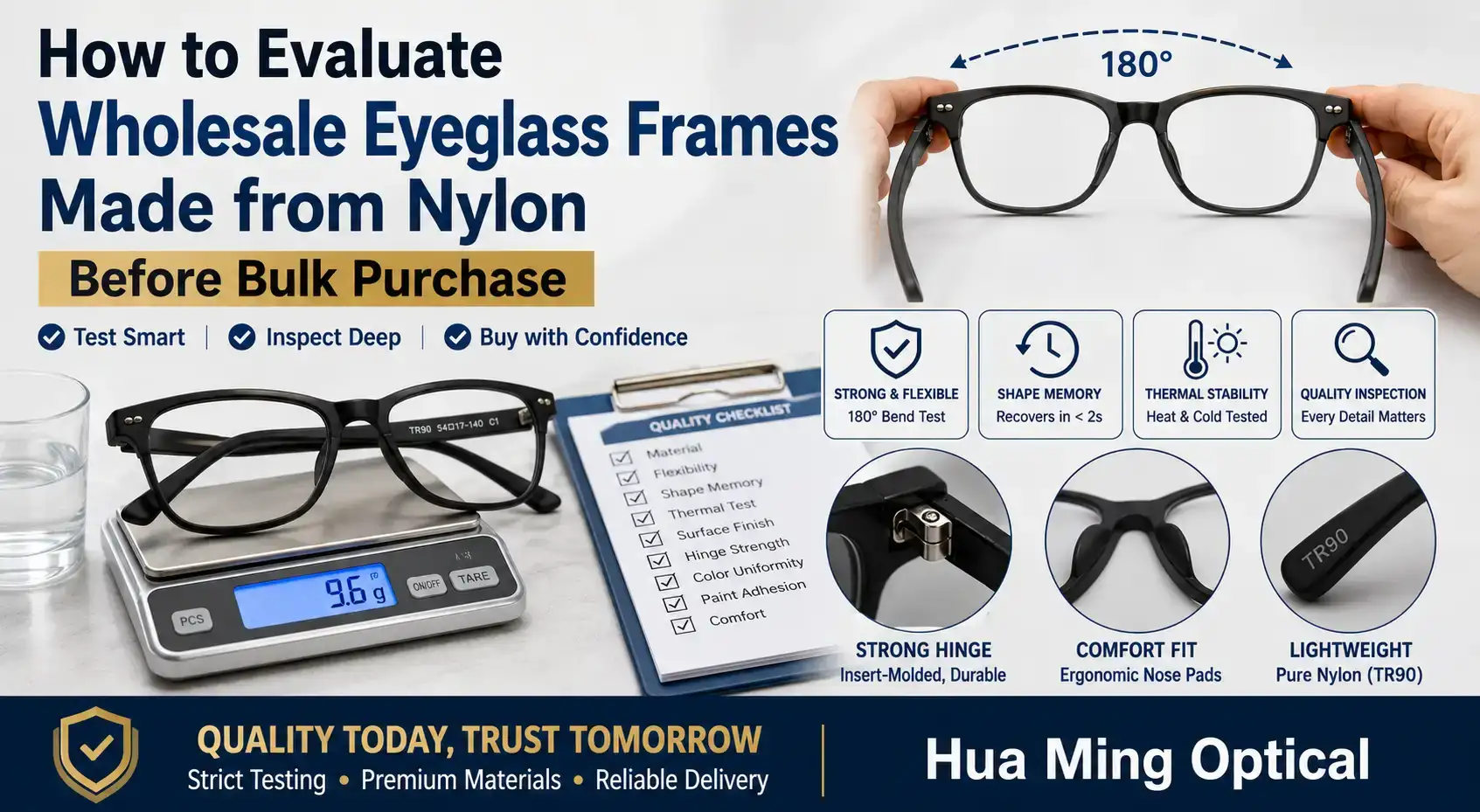
Two samples arrive in the same week, both described as TR90, both light and both priced to win your order. One flexes and springs back cleanly. The other shows a pale mark near the bridge after a gentle bend. On a catalog page they look identical, yet only one of them is likely to keep your returns low. A few hours of checking at the sample stage can tell you which is which, and it costs far less than discovering the difference after a deposit has been paid.
This guide shows you how to compare what each nylon eyeglass frame supplier sends you. It starts with the material, then moves through simple checks you can run in your own office, followed by the reports worth asking for. The hands-on checks here are quick screens for comparing samples. They do not replace laboratory testing, and any limits should be agreed with your factory in writing.
Start With the Material Behind the Sample
What "Nylon" and "TR90" Mean
Nylon belongs to the polyamide family, and eyeglass frames made from it are shaped by injection molding. Grilamid TR 90 is a transparent polyamide grade from the Swiss company EMS, with a density of about 1.00. The term "TR90" is often used loosely on quotes, so it does not prove which resin is in your sample. Other grades exist as well, such as Grilamid BTR, which carries up to 54% bio-based content.
Ask for the resin producer and the exact grade in writing, and request its data sheet. Ask too whether the factory uses regrind, which is molded scrap fed back into production, and in what share. If a claim matters to your brand, a lab can identify the polymer using an FTIR test on a sample.
Use Weight as a Comparison
Weigh each sample on a digital scale. Density gives you a useful starting point, because TR 90 is about 21% lighter than cellulose acetate by volume, and nylon-family grades generally sit between about 1.00 and 1.14. Frame weight still depends on size, thickness, hinges and any metal parts, so no single gram figure can prove quality.
Compare like with like: the same size and shape from each supplier, without lenses. If one sample is much heavier, ask why. Record the approved weight, then check that bulk production stays close to it.
Quick Checks When the Sample Arrives
Some of the most useful evidence takes only a minute to collect, and it applies to most wholesale eyeglass frame orders you place. A sample with several small issues gives you a preview of what a full shipment could look like.
- Edges: Run a fingertip along the inner rim and temple tips. Clean, smooth edges suggest that finishing has not been rushed.
- Mold flash: Look along the outer rim for a raised seam. A rough ridge can point to worn tooling, and that often gets worse in volume.
- Color and clarity: Hold the sample under strong light and look for streaks, bubbles or cloudy patches.
- Symmetry: Place the frame on a flat table with its temples open. Both temples should touch the surface evenly.
Hands-On Flex and Temperature Checks
These checks can damage a frame, so use spare samples and treat every supplier's sample in the same way. Record your method, then you can repeat it on the next round.
Flex Check
Flexibility is the main reason buyers choose this material. Hold the front firmly and slowly open the temples outward, stopping at a limit you have agreed with the factory. Watch the bridge and the hinge area closely. Pale stress marks can suggest that the material or molding is not performing as it should. A crack is a clear fail.
Shape Recovery
Measure the distance between the temple tips before you start. Release the temples after the flex check, leave the frame for a moment and measure again. A good sample returns close to its original measurement and stays straight. If it stays wide or twists, the frame may feel loose on the wearer within a short time. Compare suppliers using the same steps, because there is no universal recovery time to aim for.
Heat and Cold
Eyeglass frames get left in hot cars and carried through cold winters, so temperature matters. Ask for lab results on dimensional stability at elevated temperature, which forms part of ISO 12870 testing. If you want a simple comparison of your own, place samples from each supplier in warm water at the same temperature for the same time, then look for warping or softness. For cold weather performance, ask the factory what impact testing it has done on that grade.
Fitting needs a separate word. Grilamid frames are cold glazed, so lenses go in without heating, and retail clients should avoid using a frame warmer on them. Check how your sample takes a lens at room temperature.
Hinges and Fit
Hinge Attachment
Hinges are a common failure point on eyeglass frames. Ask how each hinge is fixed to the plastic. Insert molding sets the metal part into the frame during molding, while ultrasonic insertion and heat staking fix it afterward. Each can work when done well, so check the pull-out and cycle test results for the method used. Be wary of a hinge that simply seems glued into a slot. Open and close the temples many times, and check that the screw stays firm and the action stays even.
Nose Area and Balance
Many of these eyeglass frames have molded nose pads, which cannot be adjusted like metal pad arms. Nylon frames are generally hard to adjust, so the molded fit has to be right from the start. Pads should spread the weight evenly and have no sharp ridges. Try the sample on people who match your market, and check whether a low-bridge fit is needed.
Coating and Surface Checks
Rub Check
Many eyeglass frames receive a spray coating for color or a matte feel. A simple rub check can reveal a weak finish. Dampen a white cloth with isopropyl alcohol, rub one hidden spot an agreed number of times, then check the cloth and the surface for color transfer or cloudiness. Some nylon materials are sensitive to solvents, so try this on a spare sample and treat a poor result as a reason to ask questions. Compare it with the lens cleaner your retailers use.
Sweat and Sunlight
Skin oils, sweat and hair products all reach the frame in daily wear. An office test cannot fully copy that, so ask for a perspiration test result under ISO 12870, which uses artificial sweat. UV is a separate question. EMS offers UV-improved versions of TR 90, so ask which grade you are getting and whether color stability has been tested on your chosen shade.
Reports to Request
ISO 12870 is the international standard for spectacle frames. It covers areas such as dimensions, perspiration resistance, bridge deformation, lens retention and endurance. Ask for a recent report on the actual eyeglass frame style, and check that the company name on it matches your supplier. Reports for a different frame do not cover yours.
ABDO, the UK association of dispensing opticians, describes nylon frames as hypoallergenic because they contain no plasticizers. Treat this as a helpful point about the base material, and avoid promising that a finished frame suits every wearer, since coatings and metal parts also touch the skin. If frames carry metal hinges or parts that contact the skin, EU sales also bring the nickel release limit of 0.5 µg/cm² per week.
Once samples are approved, write the checks into your order. A pre-shipment inspection using an AQL plan compares the bulk goods with your approved sample. Buyers commonly use 2.5 for major defects and 4.0 for minor ones.
Reading the Supplier During the Sample Stage
The way a factory handles samples often shows how it will handle production. Ask for a sample date and see whether it is met. Request a written quote that separates sample cost, tooling, MOQ and unit price by quantity, then compare that structure across two or three suppliers. Numbers that keep changing between conversations are a warning sign.
Technical questions help as well. Ask about the resin grade and the hinge method in separate messages, before the sample arrives. A factory that gives clear, consistent answers is usually easier to work with than one that replies with general sales wording.
Sample Evaluation Table
| Check | Good Sign | Warning Sign | Done By |
|---|---|---|---|
| Material grade | Named producer, grade and data sheet | Only "TR90" or "nylon" on the quote | Buyer, lab if needed |
| Weight | Close to the agreed sample weight | Unexplained gap on the same shape | Buyer |
| Molding finish | Smooth edges, faint seam | Rough flash, streaks or bubbles | Buyer |
| Flex and recovery | No marks, returns close to its shape | Pale marks, cracks or twisting | Buyer |
| Temperature | Stable shape, report available | Warping or no data | Lab, buyer comparison |
| Hinges | Clear method, test results, even action | Loose parts or an unknown method | Buyer and factory |
| Coating | No transfer, cloudiness or peeling | Color on the cloth or a lifted surface | Buyer, lab |
| Reports | Recent ISO 12870 report on this style | Old, unrelated or missing reports | Buyer |
Common Questions
How Much Should Eyeglass Frames Made from Nylon Weigh?
There is no fixed figure, because size and hardware change the result. Compare the same shape across suppliers, and lock in the approved sample's weight for production.
Do Nylon Frames Float?
This is not a reliable test. Hinges, screws, coatings and additives all change the result, so use grade documents and a lab test instead.
How Many Samples Should I Request?
Ask for enough to keep one approved sample untouched and use the others for damage-causing checks. A set of two or three per style is often a practical start.
Put Our Samples Through Your Checks
Have a checklist of your own? Ask Hua Ming Optical for sample frames along with the resin details and hinge method for each style, then run them through the checks above. We would rather you test a sample properly now than find a problem after a shipment arrives.
Featured Articles
Walk through almost any optical store and you will see the same split: one wall of warm, colorful acetate and another of slim metal. A wholesale buyer has to decide how much of each to carry long before a customer tries anything on. Neither material is better in every case. Whether you are comparing metal eyeglass frames wholesale options or building a stronger acetate line, the right answer depends on who your retailers serve, what price they sell at and how much risk you want to hold in stock. This guide compares the two materials on the points that matter when you are buying in volume: how they are made, how they look and feel, how they fit, what they mean for skin sensitivity, how they affect cost and how they hold up after sale. By the end, you should have a clear way to decide which material to stock first and how to balance the two. Understanding Acetate as a B2B Asset Cellulose acetate is a plant-based plastic made from cellulose, usually from cotton or wood pulp, mixed with plasticizers and color. It is produced as sheets or blocks, and frame parts are then cut by CNC machines, tumbled and polished. Because color and pattern run through the material, a tortoiseshell or layered design has a depth that surface paint cannot match. Retailers can see and explain that value at the counter. Acetate is also a thermoplastic. It softens with heat, so opticians can reshape it to fit different faces. That helps retailers sell a style to a wider range of customers without carrying as many sizes. Acetate does have limits. Plasticizers can slowly leave the material over the years, which can make older frames more brittle, and colors can change with long exposure to strong light. Good sheet and careful finishing reduce those risks but do not remove them. Durability and Benefits of Metal Eyeglass Frames Metal defines the slim and professional side of the eyewear market. The word covers several materials. Stainless steel offers strength and corrosion resistance at a reasonable cost. Titanium is very light and strong, and it usually costs more. Monel is easy to shape and adjust, though it relies on good plating. Each one brings a different balance of price, weight and risk, so "metal" alone tells you very little about a quote. The main benefits are thin profiles and easy fine-tuning. Adjustable nose pads help opticians fit a frame to many different noses, which is valuable when a retailer serves a broad customer base. Metal frames depend heavily on what happens after shaping, however. Joints, hinges and plating all decide how well a style will age, so inspect them closely on every sample. How Acetate and Metal Compare Feature Acetate Frames Metal Frames Material base Plant-based cellulose with plasticizers Stainless steel, titanium, Monel and other alloys Look Bold shapes, deep color and patterns Slim lines and a minimal look Color source Runs through the sheet Plating or coating on the surface Adjustment Softened with heat Bent by hand, with adjustable nose pads on many styles Skin sensitivity Usually well tolerated; plasticizers may matter to some wearers Depends on alloy, nickel content and coating Main quality risk Shrinkage, brittleness with age Coating wear, weak joints Usual market Fashion and boutique ranges Professional and everyday ranges Style and Customer Appeal Customers often choose eyeglass frames on looks first. Acetate suits people who want their glasses to be noticed, since it carries strong color, thick shapes and layered patterns well. It also photographs and displays strongly on a shelf. Metal suits people who want their glasses to sit quietly on the face, such as office workers, professionals and anyone with a minimal style. Think about the store as well as the wearer. A boutique may sell acetate through its story and color range, while a busy optical chain may rely on dependable metal shapes in safe finishes. Age groups and local fashion can shift this balance, so ask your retailers what actually sells before you settle on a mix. Weight and Comfort Weight depends on both the material and the design. Acetate has a density of about 1.27, and it is often used in thicker shapes, so a bold frame can feel solid on the nose. Well-designed nose pads and balanced temples make a big difference to comfort. Thin metal designs can feel very light, particularly in titanium, although a heavy metal front can still press on the nose. Because design matters so much, compare eyeglass frames by weighing real samples of the same size. Then ask a few people to wear them for an hour or two. Comfort complaints usually show up with time, and they rarely show up in the first minute of trying a frame on. Fit and Adjustment Fit is a real sales tool, because eyeglass frames that sit well are less likely to come back. Acetate adjusts with heat, so opticians can shape the temples and front to suit a wearer. The bridge is usually molded or shaped into the front, which means the nose fit is more fixed unless the frame has adjustable pads or a low-bridge design. Metal frames offer a different kind of adjustment. Temples and front can be carefully bent by hand, and pad arms let the optician set the height and angle of the nose pads. This helps with wearers who have narrow bridges or uneven features. Memory metal is an exception, because it resists small adjustments. Rimless styles also need more care during fitting. Skin Sensitivity: A Return-Rate Risk Buyers Often Overlook Skin reactions cost more than a single refund, because they can damage a retailer's trust in your range. Acetate is generally well tolerated, but it does contain plasticizers, and some wearers may react to them or to coatings. For that reason, it is safer to avoid calling it naturally hypoallergenic. With metal, the alloy is the main question. Nickel is a leading cause of skin allergies. Monel and nickel silver contain it, and so do common stainless steel grades such as 304 and 316, even though stainless steel is sometimes sold as nickel-free. Pure titanium is hypoallergenic, while blends need checking. Plating helps for a while, but it can wear through at the nose and temple tips. If you sell in the EU, ask for an EN 16128 test report, since the nickel release limit is 0.5 µg/cm² per week. The unit price of a metal batch is therefore not the only number that matters. A slightly cheaper alloy or thinner finish can bring more complaints later. Keeping a titanium option in the range gives retailers something to offer wearers who have a known sensitivity. Cost, Pricing and Margin No single price comparison holds across the board, since a basic stainless steel frame and a titanium frame sit at very different levels, as do extruded and block acetate. Compare like with like. Ask for a quote that shows sheet type or alloy, finish, hinge and quantity. Then work out your landed cost, including freight and duty, before you compare margins. Perceived value matters as well. A deep tortoiseshell acetate can justify a strong retail price through its look. A titanium frame can justify one through its light weight. Your margin depends on how well the retail price matches what the customer can see and feel. Storage and Shipping Metal frames are slim, which may help when goods are packed without cases. Once cases and boxes are added, the difference can shrink, so ask for carton counts and weights on your actual order before you assume any shipping saving. Each material also needs proper protection in transit. Acetate should be kept away from heat, and metal parts should be kept dry and separated so that finishes do not rub. Quality and Long-Term Reliability Hinges decide how long many eyeglass frames last. Spring hinges flex outward and can help a frame stay comfortable through daily use, while barrel hinges are simple and easy to service. When sourcing your next batch of wholesale acetate eyeglass frames, check that hinges are firmly fixed and move smoothly, and ask whether the temples have a wire core for support. On metal frames, look closely at the bridge joints, the end pieces and the plating near the temple tips. ISO 12870 is the international standard for spectacle frames, and it covers perspiration resistance, bridge deformation and endurance. Reports on your actual style are far more useful than a general quality statement. Which Should You Stock First? Start with your main buyer. If your customers are fashion boutiques or private-label brands, lead with acetate, as color and shape will drive their sales. If they are optical chains or stores serving professionals, metal may anchor the first order, since dependable shapes and easy fitting matter most. Customers with stronger prescriptions can also be worth considering. A thicker acetate rim can help hide a thick lens edge, while a thin metal rim may leave it showing. Most established wholesalers end up stocking both. There is no fixed split that suits every business, so let your own sell-through set the mix. Begin with a small range in each material, track what sells over a season and then move your budget toward the stronger performer. A dependable wholesale eyeglass frame supplier should be able to support that kind of testing with sensible first orders and clear reorder terms. Common Questions Are Acetate Frames Better Than Metal Frames? Neither is better overall. Acetate leads on color and bold style, while metal leads on slim profiles and adjustable nose pads. Choose by the customer and the price point. Which Material Causes Fewer Skin Complaints? Pure titanium and well-made acetate are usually lower-risk choices. Nickel-bearing metals carry more risk, particularly as coatings wear. Which Material Lasts Longer? That depends on the grade, finish and care. Good acetate can be polished and refitted, while good metal frames can be repaired and adjusted. Weak hinges or thin plating will shorten the life of either. Build the Right Mix for Your Buyers Deciding how to split your next order? Tell Hua Ming Optical who your retailers serve and the price range you need to hit, and ask for acetate and metal samples to compare side by side. Seeing both on the same table makes the choice far easier.
READ FULLFinding a professional metal eyeglass frames supplier is the most critical step for your optical business growth. When you buy optical inventory in bulk, you invest a large amount of capital into products that your retail customers will wear daily on their faces. Metal eyeglass frames depend on base alloys such as Monel and stainless steel, multi-layer electroplating, precise spring hinge assembly, and perfect surface polishing to satisfy professional opticians and retail buyers. A single oversight in evaluating your eyewear manufacturing partner can lead to severe structural failures like snapping frame bridges, peeling metal coatings, lost retail clients, and permanent damage to your corporate brand reputation. Many global optical buyers make the fundamental mistake of focusing only on the lowest unit price list during their initial factory assessment. However, the wholesale eyewear market contains many unverified trading companies and low-end assembly workshops that use clever digital marketing to hide their operational weaknesses. You need to know exactly how to spot the structural and legal warning signs before you sign any contract or send your financial deposit for custom metal frames. This guide details the main warning signs to check when you evaluate potential partners for long-term business growth. By learning to identify these factory warning signs early in the negotiation phase, you can protect your capital investment and build a highly secure supply chain for your eyewear lines. Reliable optical manufacturers tend to be open about their operations, quality standards and business practices. The sections below go through the warning signs area by area, so that you can make a safe and profitable decision. 01. Unverified Business Credentials Every legitimate metal eyewear factory operates under a strict legal framework established by their local government and international trade authorities. When you buy optical frames in bulk, you are establishing a commercial relationship that requires comprehensive legal protection. If a company cannot prove its legal manufacturing existence or corporate business status for optical production, you face an immediate risk of losing your investment. 1.1. No business registration or license proof A legitimate metal eyewear manufacturer should be able to show an official business registration certificate that matches the company you are paying. If you ask a supplier for their business license and they make continuous excuses, treat that as a warning sign. An unregistered operation may also fall short on local rules for chemical plating and labor, and if it is forced to close, your production order and deposit could be at risk. Always verify the official corporate name, registration number, and legal ownership status before you move forward with any business contract. 1.2. Missing company address or factory details Real metal eyewear factories have physical, industrial locations equipped with heavy hydraulic stamping machines, automated wire-bending equipment, CNC milling stations, and specialized polishing lines. A major red flag is when an online supplier only provides a generic mobile phone number or a basic email address without a physical factory street address. If their website only shows a digital contact form and lacks a real physical office or factory location, you may be dealing with a small trading agent and not a factory. You should always ask for the exact physical address and verify it using satellite maps or independent third-party inspection services. A real manufacturer will usually share its location and can offer a live video tour of its machinery. 1.3. No export/import documentation (for international suppliers) Shipping metal eyeglass frames across international borders requires specific customs paperwork, export licenses, and trade code registrations. If you plan to import in bulk, your supplier should know how to handle international freight documentation smoothly. Be careful if a supplier suggests complicated shipping methods or asks you to clear customs under a false product description. Poor documentation can cause delays, fines or the seizure of your shipment. 02. Poor Product Quality Control Metal eyewear requires exceptional structural durability because these products face constant twisting, bending, and human sweat exposure. Good frames use alloys such as Monel, stainless steel or pure titanium, with protective finishes suited to each metal. If a supplier has no strict quality control process, you are far more likely to receive goods that fail in the retail market. 2.1. Inconsistent frame finishing (scratches, uneven coating) The surface electroplating treatment of a metal frame determines its visual beauty and its resistance to skin corrosion. When you inspect a supplier's production lot, the metal surfaces should be perfectly smooth with an even paint or lacquer thickness. A critical red flag is finding minor scratches, tiny air bubbles, or uneven color thickness across different parts of the temple arms or lens rims. Poor electroplating can make the color peel off early, which can lead to complaints about skin irritation and discoloration. 2.2. Weak metal durability or bending issues Eyeglass frames must maintain their original shape while holding optical lenses under constant tension. If the raw metal material is cheap or improperly heat-treated, the frame rims will warp or bend out of shape under slight manual pressure. Check the spring hinges, bridge welds, and temple wires for structural strength during your technical assessment. Weak base metals or poor soldering points at the bridge and nose pad arms will break easily during lens insertion by opticians or routine adjustments by the end-user. 2.3. No quality inspection reports or QC process A professional factory tracks production using standard quality control sheets, from raw wire to finished eyeglass frames. Typical checks include stress tests, salt spray tests for corrosion, perspiration resistance and hinge cycle tests. ISO 12870 is the international standard for spectacle frames, and EN 16128 is the test for nickel release, with an EU limit of 0.5 µg/cm² per week. If a supplier cannot show you a written quality control process or recent reports on the style you are buying, it may not be checking its products properly. Buying from a supplier without an established inspection process means you are gambling with the quality of your optical inventory. Metal Frame Inspection Type What to Expect Red Flag Warning Sign Salt spray test Report on metal and finish corrosion for agreed test hours No report, or color fades or rusts quickly Perspiration resistance Test result under ISO 12870 on this style Salt spray offered as a sweat test Hinge durability test Cycle count and method agreed in writing Loose screws or a number with no method behind it Material verification Named alloy and grade with a certificate Unclear alloy or missing documents Nickel release EN 16128 report for goods sold in the EU "Nickel-free" claim with no test report 03. Unrealistic Pricing While saving money on inventory increases your profit margins, metal eyewear production has fixed baseline costs for raw materials, modern machinery maintenance, and skilled labor. An extreme price often points to a hidden problem that can hurt your business later. 3.1. Prices far below market standard without explanation If a supplier offers you a unit price that is significantly lower than every other factory quotation, you must be extremely cautious. Eyewear manufacturing requires expensive metal alloys and precise polishing work. A very low price can mean lower-grade metal, thinner plating or skipped coating layers. Frames made this way may fail quality checks, and they can create compliance problems in your market. 3.2. Hidden costs added later in quotation Dishonest suppliers use a classic bait-and-switch strategy to trap buyers. They will give you an incredibly low initial estimate to start the conversation and get your commitment. Once you prepare to place the order, they suddenly add unexpected fees for mold maintenance, export packaging, local logistics, or administrative handling. A trustworthy partner will give you a clear, itemized quotation from the start of your negotiation. 3.3. No clear breakdown of unit price vs MOQ pricing Mass production relies on economies of scale, meaning the price per unit should drop clearly as the order volume increases. A supplier who refuses to provide a clear pricing tier based on different order quantities is a major red flag. This lack of clarity can suggest that the seller is guessing at prices and has not calculated real material costs and machine time. 04. Weak Communication & Responsiveness International business partnerships require clear, fast, and accurate communication to keep production schedules on track. Miscommunications in technical specifications lead directly to manufacturing errors and missed market deadlines. 4.1. Slow reply time to inquiries If a supplier takes several days to reply to a simple email or text message during the sales phase, their communication may get worse after they receive your deposit. Slow replies can suggest that the company is understaffed, disorganized or not very interested in your business. When production issues occur or shipping delays happen, you need a partner who responds quickly and solves the problem before it hurts your retail operations. 4.2. Unclear answers about materials or production When you ask specific questions about the type of stainless steel used, the origin of the hinges, or the specific lead time, you should receive direct technical answers. A red flag is when the sales representative gives vague answers like "our quality is the best" or avoids the technical questions completely. This can mean that the representative lacks basic product knowledge, or that the true origin and specifications of the materials are being kept from you. 4.3. No dedicated sales/support contact A reliable wholesale manufacturer assigns a specific account manager or sales engineer to handle your business requirements. If you must talk to a different person every time you call, or if your emails go to a generic, unmonitored public mailbox, your order details can easily get lost. It may also mean the company is not set up to manage long-term commercial clients. 05. MOQ & Production Issues Minimum Order Quantity policies reflect a factory's production capacity and setup costs. Unstable or confusing production policies indicate internal operational chaos inside the factory management team. 5.1. No clear minimum order quantity policy Every organized factory knows exactly how many units they must produce in a single machine run to cover their overhead costs. Distributors of open stock can be flexible on quantity, but a company that calls itself a factory and has no MOQ rules at all deserves questions. It may be buying leftover stock or factory seconds, which would mean you cannot reorder the same designs later. 5.2. Frequent changes in MOQ after agreement If a supplier agrees to a specific order volume during the negotiation and then suddenly raises the minimum requirement before production starts, you are dealing with an unreliable partner. They use this trick to force you into spending more money after you have already invested time in designing or selecting the styles. Get agreed terms in writing, and think twice about a company that keeps changing them. 06. Lack of Customization Capability To stand out in the competitive optical market, your brand needs unique style elements and original design features. A supplier who cannot customize products will limit your brand to basic commodities. 6.1. Limited frame design options An active eyewear manufacturer usually keeps developing new frame shapes, whether through an in-house team or design partners. If a supplier's catalog only contains a few outdated styles from years ago, it may not be following the market. Old, generic shapes make it harder for your retail clients to earn premium prices in their stores. 6.2. No OEM/ODM support or refusal to modify designs Buyers and retailers often ask for specific colors, custom logos and original designs, and many factories support this through OEM and ODM work. If a factory cannot work from a technical 2D drawing or a 3D digital model, developing an exclusive collection with it will be difficult. Custom stamping and laser engraving are also worth asking about, since a factory without them may leave you selling the same generic designs as your competitors. Sometimes you only need to change a small detail, such as lengthening a temple tip, widening a nose bridge or changing a color finish. If a supplier refuses even these small changes, it may be limited by its tooling, or it may be buying pre-made frames from elsewhere and have little control over production. Ask directly which steps it handles in-house. 07. No Sample Policy or Delayed Samples Samples are the ultimate test of a supplier's true product quality, technical accuracy, and operational efficiency before you commit to a large purchase order. 7.1. Refusal to provide samples A serious commercial buyer should be able to get a sample, even if a fee applies. If a supplier will not send samples under any circumstances, treat that as a major warning sign, because you have no way of judging its materials and construction up close. 7.2. Excessively expensive sample charges While it is normal to pay a reasonable fee for prototypes and shipping, the cost should be sensible. If a supplier demands an unusually high fee for a single stock frame that needs no custom tooling, ask why. This can suggest that it is more interested in one-time fees than in a long-term wholesale relationship. 7.3. Long delays in sample delivery If a factory takes several weeks or months just to ship out a pair of standard frames from their current stock, something is wrong with its internal organization. If it cannot handle a simple sample shipment well, your main order may face delays that hurt your seasonal retail sales. 08. Weak After-Sales Support Your business relationship with a manufacturer does not end when the shipping container leaves the factory loading dock. True business success requires a partner who stands behind their work if things go wrong. 8.1. No warranty or replacement policy Every physical manufacturing process has a small, natural percentage of defects due to machine tolerances or human assembly errors. A professional factory should state clearly how it handles these issues. If a supplier states that all sales are final and refuses to offer any warranty protection, you carry the full financial risk of any factory mistakes. 8.2. No handling of defective batches If your retail clients start returning frames due to a widespread structural failure like a bad solder point, you need immediate help. An unreliable supplier will ignore your emails, blame your shipping carrier, or claim that your customers broke the frames through improper use. A real partner will investigate the batch and agree a fair remedy, such as credit notes or replacement goods, under the terms you set in advance. 8.3. No long-term partnership commitment Unreliable suppliers focus exclusively on the immediate transactional profit of a single invoice. If a supplier shows no interest in learning about your local market, understanding your business goals, or helping you scale your order volume over time, they are a temporary vendor rather than a true strategic partner. Comprehensive Evaluation Framework for Eyewear Sourcing Bring these checks together into a simple verification routine. A reliable eyeglass frame supplier will welcome a structured review like this one, and it can save your business from costly errors. Verify Legal Registration: Always request a copy of the official business license and check the factory address through physical inspection or independent local agencies. Audit Technical Testing: Ask to see recent material certificates and laboratory test reports for plating durability and metal composition. Evaluate Communication Speed: Track how fast the sales team answers technical product questions during your initial negotiation weeks. Inspect Prototype Quality: Never skip the sample phase; examine the finishing under a magnifying lens to check for plating flaws or weak solder joints. Confirm After-Sales Written Terms: Check that the final commercial contract explicitly defines the replacement policy for defective components before you pay the deposit. Put Us Through the Same Checks Comparing factories for your next metal range? Ask Hua Ming Optical the same questions you would ask anyone else: who makes each part, which reports apply to your style and how defects are handled. Send your design or target styles, and judge our samples for yourself.
READ FULLPut two tortoiseshell eyeglass frames side by side on a sample table. One was cut from Italian sheet and the other from a sheet made in China. They share a shape, a hinge and a finish, yet the quotes are different and your retail clients will ask why. Anyone buying wholesale acetate eyeglass frames reaches this point sooner or later, and the answer shapes unit cost, shelf price and the story your sales team can tell. The choice is rarely as simple as Italy against China. Sheet method, color complexity, order size and the actual producer often tell you more than the country on the label. This guide explains how each material is produced, where the real differences show up in finished eyeglass frames, and what to ask before you sign off on a specification. What Is Mazzucchelli Acetate? Mazzucchelli is a family-run Italian company with its headquarters in Castiglione Olona, north of Milan. It started in 1849 as a small workshop making combs and buttons from horn, bone and tortoiseshell. Acetate came much later. The company built its factory in Castiglione Olona in 1906, and a 1927 agreement with Du Pont for celluloid production led it toward cellulose acetate sheets. Six generations on, it is one of the best known names in eyewear materials. Frame makers use its sheets for three main reasons. The first is range: the company has described an archive of about 25,000 colors and combinations, built largely over the past few decades. The second is record keeping, because details of each master batch are stored so that a later batch can match the original color. The third is material development. Its M49 bio-acetate replaces certain plasticizers and pigments with organic substitutes, and Gucci was the first eyewear brand to use it. One detail surprises many buyers. Mazzucchelli has also reported sheet production in Shenzhen and Shanghai, mainly for Asian customers. A frame made from Mazzucchelli acetate is therefore not automatically made from sheet produced in Italy. If "Italian acetate" will appear in your catalog, ask your factory to confirm both the brand of the sheet and where that sheet was made. What Is Chinese Domestic Acetate? Chinese domestic acetate means cellulose acetate sheet produced by manufacturers based in China, such as Shenzhen Jimei New Materials. The basic chemistry is the same as in Italy. Cellulose from cotton or wood pulp is purified and reacted with acetic acid, then mixed with color and processed into sheets. Quality differences come from raw material purity, formulation, process control and how well each producer stabilizes the sheet after cutting. Chinese producers also work with the same three processing routes used elsewhere: extrusion, block and lamination. A 2021 seminar on the Chinese industry standard for spectacle frame acetate sheets covered tests that are useful for any buyer, including surface roughness, dimensional deviation, delamination, shrinkage, Shore hardness, Izod impact strength and bending modulus. Those test names give you a practical language for comparing suppliers, since a claim of "high quality" tells you very little. Opinions on quality still differ. Some frame makers say Chinese sheet has yet to match the best European and Japanese producers. That view is worth testing for yourself, because the Chinese market covers many producers and grades. Judge a named producer and a specific sheet code by sample, and leave the country label out of the decision. Distance is the practical advantage. When the sheet producer sits close to the frame factory, freight is simpler and small top-ups are easier to arrange. For a private label order built around a tight launch date, that shorter supply line can outweigh a small price gap. Direct Comparison: What Actually Differs Between the Two? How the Sheet Is Made Start with the process, because it often explains more than the country does. Block acetate is built from many colored elements pressed together and then sliced, so patterns can run in different directions across a frame. Extruded acetate tends to carry patterns in one direction. Laminated acetate stacks sheets during pressing and bonds them slowly, which creates the layered edge seen on two-tone eyeglass frames. Block sheet costs considerably more than extruded sheet, so a comparison between Italian block and Chinese extruded acetate is really two comparisons at once. Ask for the same method from both sources. Softer block sheet also suits bold, thick-front styles and full-rim designs, while denser extruded sheet, such as Japanese Takiron material, can work well in thinner designs. Color Depth and Clarity Color is where buyers usually notice a difference first. In a well-made tortoiseshell block, amber, brown and black seem to sit at different depths inside the frame. A simpler sheet can look flatter under the same light. Depth comes from how the pattern was built, so a low-cost Italian extruded sheet and a high-grade Chinese block sheet may not rank the way the labels suggest. Clear and crystal colors are the hardest test. Hold a transparent sample against white card under neutral light and look for yellow or gray tint, cloudiness and trapped particles. Compare finished eyeglass frames, since polishing and lacquer can change how clear a sheet appears. Surface Polish Quality Both materials take a strong shine through tumbling and hand buffing, and much of the result comes from the factory's finishing work. Long tumbling cycles, careful edge polishing and clean handling are what give a frame its wet look. A good sheet in a rushed finishing line will still disappoint. To test this fairly, ask for the same front shape in both materials, finished on the same line. Compare the gloss, then handle both samples for a few weeks and check how the surface wears. Premium optical retailers will notice small differences that a volume fashion buyer may never raise. Consistency Across Production Batches Batch records make color repeatable, and this is one of the stronger reasons brands pay for an established sheet supplier. Reorders are where it counts. A tortoiseshell that drifts between your spring and autumn deliveries creates mismatched stock on the same shelf. Patterned acetate will still vary from frame to frame, because each front is cut from a different area of the sheet. Agree an approved range using limit samples, then write that range into the order. With Chinese sheet, batch variation depends heavily on the producer, so name the mill and sheet code in your purchase order. Stability and Aging Sheet needs time and controlled heat to settle after it is cut. Poorly stabilized acetate can shrink, and a temple that draws back may expose its wire core. This problem rarely appears on the day a sample arrives, which is why shrinkage data is worth requesting. Storage matters too: sheets should lie flat in a dry, ventilated room. Cost Difference on a Real Order A premium sheet raises unit cost, but the size of that increase depends on sheet method, color, thickness, frame size and how much material each front wastes. Avoid general percentages. Ask your factory to quote one style twice, using the same hinge, finish and quantity, with only the sheet changed. That gives you the real gap for your own order. Then test the gap against your selling price. Where the extra cost is small next to the retail price and the material name helps sell the frame, the premium sheet may pay for itself. Where a tight wholesale price leaves little room, the same cost can decide whether a style sells at all. Factor Mazzucchelli Acetate Chinese Domestic Acetate Main strength Color range, batch records, brand recognition Lower sheet cost, close supply Processing routes Block, extrusion, lamination Block, extrusion, lamination Quality spread One named supplier Varies by producer and grade Check before ordering Sheet origin and color code Producer name, sheet code, test data Usual fit Boutique and designer collections Volume and mid-range collections Which Acetate Is Right for Your Business? Choose Mazzucchelli When: Your retail price leaves room for a higher sheet cost and your customers expect a named material You are building a private label line that sits beside established fashion eyewear brands Your clients are independent boutiques or designer optical stores, where material origin comes up during the sale You need to reorder the same color over several seasons and want strong batch records behind it You want to use the supplier's name in your catalog and can document it Choose Chinese Domestic Acetate When: Your wholesale price target leaves little room for material cost You supply high-volume optical chains, where price and availability drive the order You need custom colors or patterns on a shorter sourcing timeline Your collection targets everyday fashion eyewear instead of premium optical shops You are ordering corporate or promotional eyeglass frames, where function matters more than the material name The Hybrid Approach Many collections do not need one answer. A brand can specify premium sheet for its hero styles and use well-chosen Chinese acetate for its volume line. The hero styles carry the story while the volume line carries the turnover. Keep the two ranges clearly named in your catalog so that a retailer always knows which material sits behind which price. Rounding Out Your Catalog If your buyers also ask for something lighter and more flexible, a nylon eyeglass frame collection can sit alongside your acetate range and serve active customers. Questions to Ask Before Specifying Acetate Material A material name on a quote proves little until the paperwork supports it. Before you approve a specification, put these questions to your eyeglass frame manufacturing partner and ask for the answers in writing: Which company produced this sheet, and in which country was it made? What is the sheet code, and can I see its specification sheet or origin document? Is this block, extruded or laminated sheet? What checks do you run on incoming sheet before cutting, and do you have shrinkage data? How will you control color across a large order and on future reorders? Can I mix sheet sources across styles within one order? A clear answer with documents behind it tells you a lot about how a factory runs. Making the Right Material Decision for Your Brand Choosing between these two sources is a brand decision as much as a material one. Mazzucchelli gives you a recognized name, a deep color library and strong batch records, and you pay for those strengths. A good Chinese sheet gives you cost control and closer supply, and it asks you to do more checking on the producer. Both can make fine eyeglass frames when the sheet method suits the design and the factory finishes it well. Base the decision on samples, written specifications and your real selling price. A side-by-side quote on one style will usually tell you more than any general rule about Italian or Chinese material. Compare Your Acetate Options Still weighing up sheet options for your next acetate line? Send your target style and price range to Hua Ming Optical, and our team can talk through where each material fits your collection and order size. A direct conversation before you fix the specification can save a costly change later.
READ FULL